Peasants' AI
Who selects the knowledge base decides whom the algorithm serves

On the afternoon of May 16, 2026, Livraria Expressão Popular—a bookstore in São Paulo operated by Expressão Popular, the publishing house of Brazil’s Landless Workers’ Movement (MST)—was packed wall to wall. There were no stage lights, no product demos on enormous screens, no executives in black turtlenecks. The people filling every corner of the room were farmers, agroecology technicians, and social movement organizers who had traveled from across Brazil to be there. The launch was held right after the presentation of a book titled Além do Vale do Silício (”Beyond Silicon Valley”)—a Brazilian edition of my book on China’s AI development, itself a collection drawn from this column. The pairing was not incidental. They had come to witness the first public demonstration of something called IARAA—Inteligência Artificial da Reforma Agrária e Agroecologia, an AI platform for agrarian reform and agroecology.
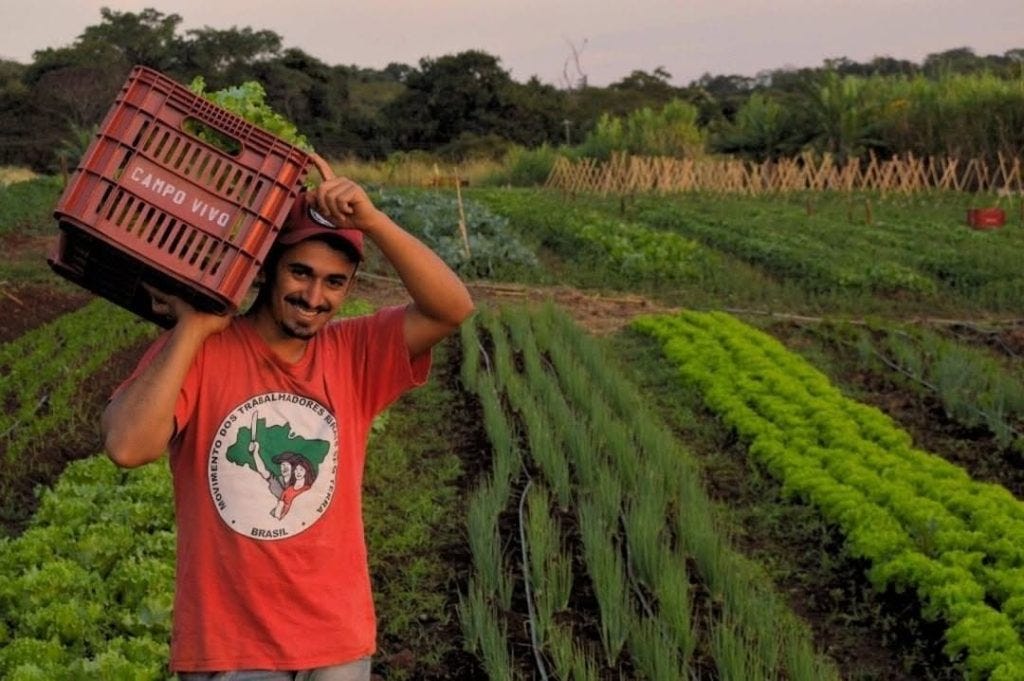
What made the event unusual was not just the setting—a bookstore rather than a convention center—but who had built the tool on display. IARAA was not the product of a tech company. Its prompt engineering, content curation, and algorithmic flow design had been carried out by MST and World March of Women (MMM) cadres, working under the technical guidance of two professional programmers. Movement militants had learned to do the core building themselves.
Not Programmers, Builders
The people behind IARAA were not software engineers. They were agroecology specialists who had spent years advising farmers on pest management without chemicals, land reform organizers who had led occupations and built settlements from scratch, community educators who ran literacy programs and political training courses—people who understood soil and seeds far better than code. Working under the guidance of two professional programmers, they learned to shape the behavior of large language models: designing the prompts that steer how the system responds, curating the knowledge it draws from, and building the algorithmic workflows that determine what a farmer sees on screen. Carolina Cruz, from MST’s information technology front, captured what this meant at the launch event: “We are not only developing a tool for the farmers—the farmers are inside IARAA, developing the platform.”
What they built reflects a granular understanding of how knowledge moves through a social movement—something no product team in São Paulo or San Francisco would have designed on their own. IARAA offers three response modes, each named after a form of collective agricultural labor embedded in MST’s own culture rather than after the user personas of a product manager. Semeadura (”Sowing”) is for the farmer standing in a field with a practical problem: how to control an aphid infestation without chemicals, say. The response comes in direct, accessible language, meant to be understood immediately and put to use. Mutirão (”Collective Work”) is for the technician working with a group of farmers, offering methodological suggestions for cooperative planning and shared decision-making. Quintal Produtivo (”Productive Backyard”) is for the researcher or the advanced student, delivering extensive, referenced responses grounded in academic literature. The same political commitment runs through all three. What changes is the register—calibrated to who is asking, where they are, and what kind of knowledge they can act on.
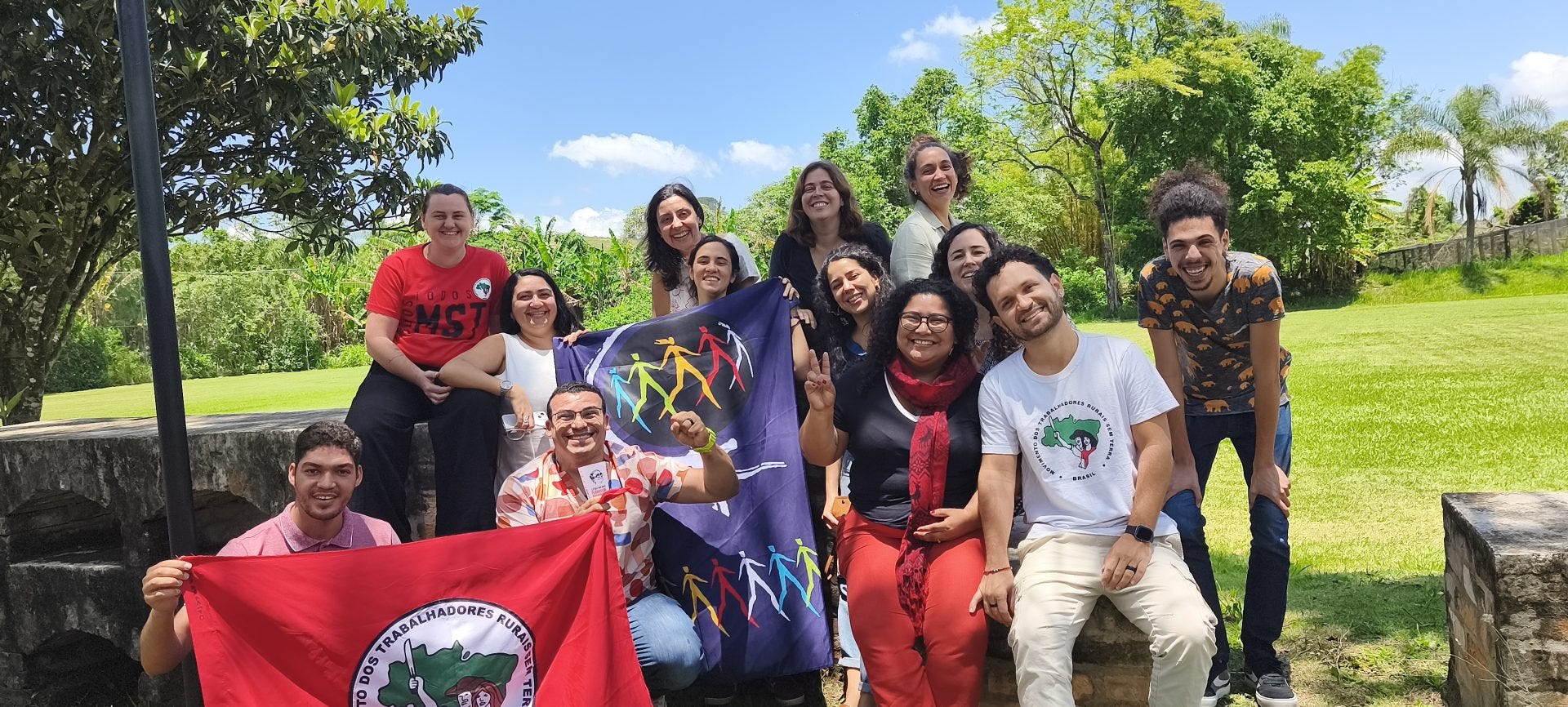
The knowledge feeding these responses was not scraped at random from the internet, as a commercial chatbot might do. MST and MMM cadres collectively curated a library spanning from 1964 to 2026—books, articles, and technical documents selected through collective discussion and debate. The Movement for Popular Sovereignty in Mining (MAM) and the Semi-Arid Articulation (ASA), two other Brazilian social movements, contributed their own specialized materials on mining sovereignty and semi-arid region management respectively. This curation process was itself a form of organizing: multiple movements sitting down together to decide what knowledge matters for farmers, where the boundaries of useful information lie, and whose expertise counts. The result is a knowledge base whose contours are shaped by movement values—whose boundaries are, in effect, the boundaries of what the movements consider legitimate knowledge. Understanding what your community needs turns out to matter more than understanding how to write code.
A Knowledge Base That Refuses to Recommend Pesticides
Tica Moreno, a militant with the World March of Women, stated the consequence clearly at the launch event: “IARAA will not recommend pesticides. It will provide answers drawn from the knowledge base produced by movements, popular organizations, and research institutions on agroecology.” This is not a technical limitation—the underlying language model is perfectly capable of generating text about chemical controls. It is a political choice embedded in the architecture. The knowledge base simply does not contain the grounds for recommending agrochemical solutions, because the people who curated it chose to prioritize agroecological methods. What a chatbot tells a farmer to do, in other words, depends entirely on who selected the books behind it.
João Pedro Stédile, a member of MST’s national coordination and one of the most prominent peasant movement leaders in Latin America, framed the divide in blunt terms at the same event. “Agribusiness is investing in technologies to reduce labor, increase profit rates, and exploit nature more,” he told the room. “We want to apply this same technology, but completely the opposite: to produce healthy food, to respect nature.” The contrast runs deeper than rhetoric. Corporate agricultural AI—deployed by companies like John Deere, BASF, and Bayer through partnerships with Microsoft and Amazon Web Services—optimizes for yield and profit margins. It treats farmers as sources of behavioral data and consumers of proprietary products. Its algorithms run on cloud infrastructure that the farmers using them cannot audit, let alone modify. IARAA optimizes for agroecological knowledge. It treats farmers as co-creators who shaped the tool itself. It runs on infrastructure the movement controls, with a knowledge base whose contents are transparent and cited in every response. The same underlying technology. Opposite logics.
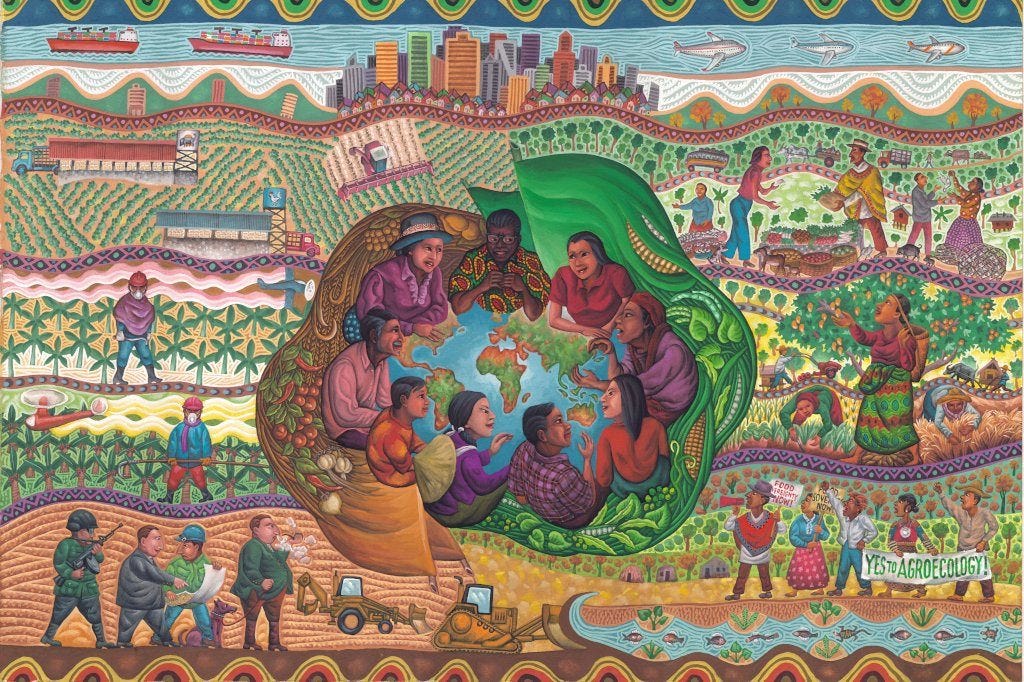
One number sharpens the structural stakes. According to Oxfam’s January 2026 report on global inequality, three billionaires control nearly 90 percent of the global chatbot market. A handful of commercial interests, in other words, will shape the AI tools that most of humanity interacts with—and the data, incentives, and priorities baked into those tools will reflect the interests of their owners, not the interests of the farmers, workers, and communities using them. IARAA represents a small but concrete break from that concentration. And it raises a practical question: what material conditions made this alternative path possible now, when it was not possible before?
The Infrastructure That Made It Possible
IARAA runs on two Chinese open-source language models—MiniMax M2.1 and GLM-4.7—connected to its curated knowledge base through a technique called retrieval-augmented generation, or RAG. The concept is straightforward: rather than letting the model generate answers purely from its general training data, the system first retrieves relevant passages from IARAA’s specific knowledge library and then constructs its response from those sources. Think of it as the difference between asking a well-read stranger for advice and asking someone who has just studied your own bookshelf. The entire stack can be deployed locally. Data never leaves Brazil. MST controls both the content of the knowledge base and the technical infrastructure that serves it.
This would not have been feasible even two years ago. Before Chinese open-source models reached their current capabilities, any organization in the Global South wanting to build applications on top of large language models had to rely on American cloud services—sending data to servers controlled by Microsoft or Amazon, with no meaningful way to audit the algorithms processing it. The cost differential is equally stark. DeepSeek R1, one of the leading Chinese open-source models, was developed for roughly $5.6 million—against an estimated $100 million for GPT-4. When Linux Foundation Research surveyed organizations worldwide, 80 percent called sovereign AI a strategic priority, and 90 percent identified open source as the essential mechanism for achieving it. The shift that Chinese open-source models have made possible is real: from being a represented user of someone else’s AI to becoming a builder of your own, on your own terms.
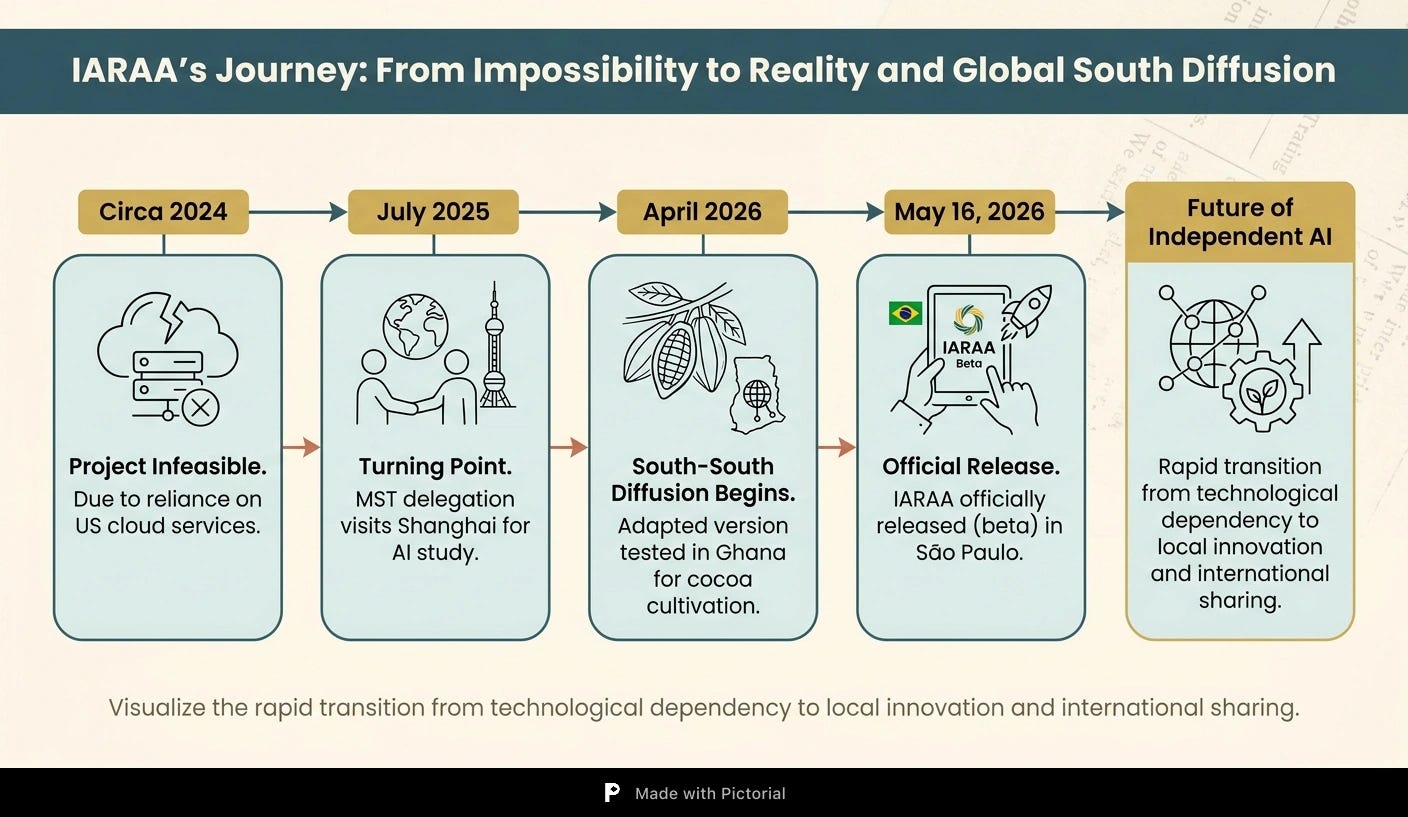
The organizational bridge that connected MST to these capabilities was Baobab—the International Association for Popular Cooperation—an organization with an office in China specifically dedicated to technological exchange among countries of the Global South. MST sent a delegation to study AI development in Shanghai in July 2025, during a course that brought together militants and specialists from several Global South countries to discuss how AI could serve popular movements rather than corporate balance sheets. Luiz Zarref, who coordinates Baobab’s Latin America office and is himself an MST member and the IARAA project coordinator, described the logic of the partnership in clear terms: “Just like tractors, bio-inputs, renewable energies, we understand that having an AI system that gathers the accumulated knowledge from movements, academia, and research institutions about agroecology and makes it available in a simple way—this is a very important contribution to the massification of agroecology.” The same collaborative chain had already produced biological inputs and machinery adapted for family-scale farming. AI was the next link in that chain, not a sudden leap into unknown territory.
That chain now extends well beyond Brazil. In April 2026, an adapted version of IARAA was tested in Ghana, focused on cocoa cultivation. Ghana is the world’s second-largest cocoa producer, and its cocoa sector is overwhelmingly dominated by smallholder farmers—people working plots of a few hectares who face many of the same knowledge-access problems as MST’s settlers. Paula Veliz, who works in Baobab’s Latin America office, described the ambition plainly: “IARAA is an initiative from the people, for the people.” The idea is to share the experience accumulated in Brazil with organizations across the Global South. The framework is deliberately designed for replication: an open-source model, a locally curated knowledge base, and a community that decides what goes into it.
What This Is—and Isn’t
IARAA is still in beta. Its builders are the first to say so. One of the design principles they encoded into the system is that IARAA should cite its sources in every response—and when the knowledge base does not contain enough material to answer a question reliably, IARAA is instructed not to answer at all, rather than inventing plausible-sounding information. It is a deliberately cautious approach, and an honest one. Tica Moreno framed the achievement in precise, unsentimental terms: “The development of IARAA has a fundamental contribution, which is placing popular organizations as subjects of technological development.” A tool for the struggle, not the struggle itself. A 2023 report by FIAN International had warned that “data will not solve hunger. Digitalization will not solve the structural problems of poverty and injustice.” MST shares that assessment. The core fight in Brazil remains what it has been for four decades: land reform, social justice, and the right of rural workers to live and produce with dignity. IARAA exists to strengthen that fight, not to substitute for it.
The significance of IARAA, then, lies not in how polished the tool is at this stage but in the path it makes visible. From the Young Lords learning acupuncture at Lincoln Hospital in New York in 1969 and declaring “each one teach one,” to MST cadres learning prompt engineering in São Paulo in 2026—a pattern stretches across more than half a century: not experts building tools on your behalf, but communities deciding they can learn to build for themselves.
Who Owns the Algorithm
What determines whom AI serves is not the sophistication of the algorithm or the scale of the computing power behind it. It is two plain questions: who selects the knowledge base, and who controls the infrastructure? MST’s cadres answered both. Chinese open-source models provided the technical foundation, but what gives IARAA its character—what makes it refuse to recommend pesticides, what makes it name its response modes after collective labor rather than market segments—is the knowledge curation and prompt design done by movement militants who have spent their lives organizing in the countryside. That framework is not limited to agriculture. Education, health care, urban planning: any domain can ask the same two questions and arrive at a fundamentally different kind of tool.
In Ghana, cocoa farmers are already testing an adapted version. Similar experiments can begin wherever a community decides it knows what it needs—and sets out to build it.
An unstoppable movement toward building a future free from exploitation and oppression.