Knowledge Unbound
A Response to Das and Borhan on AI and Labor

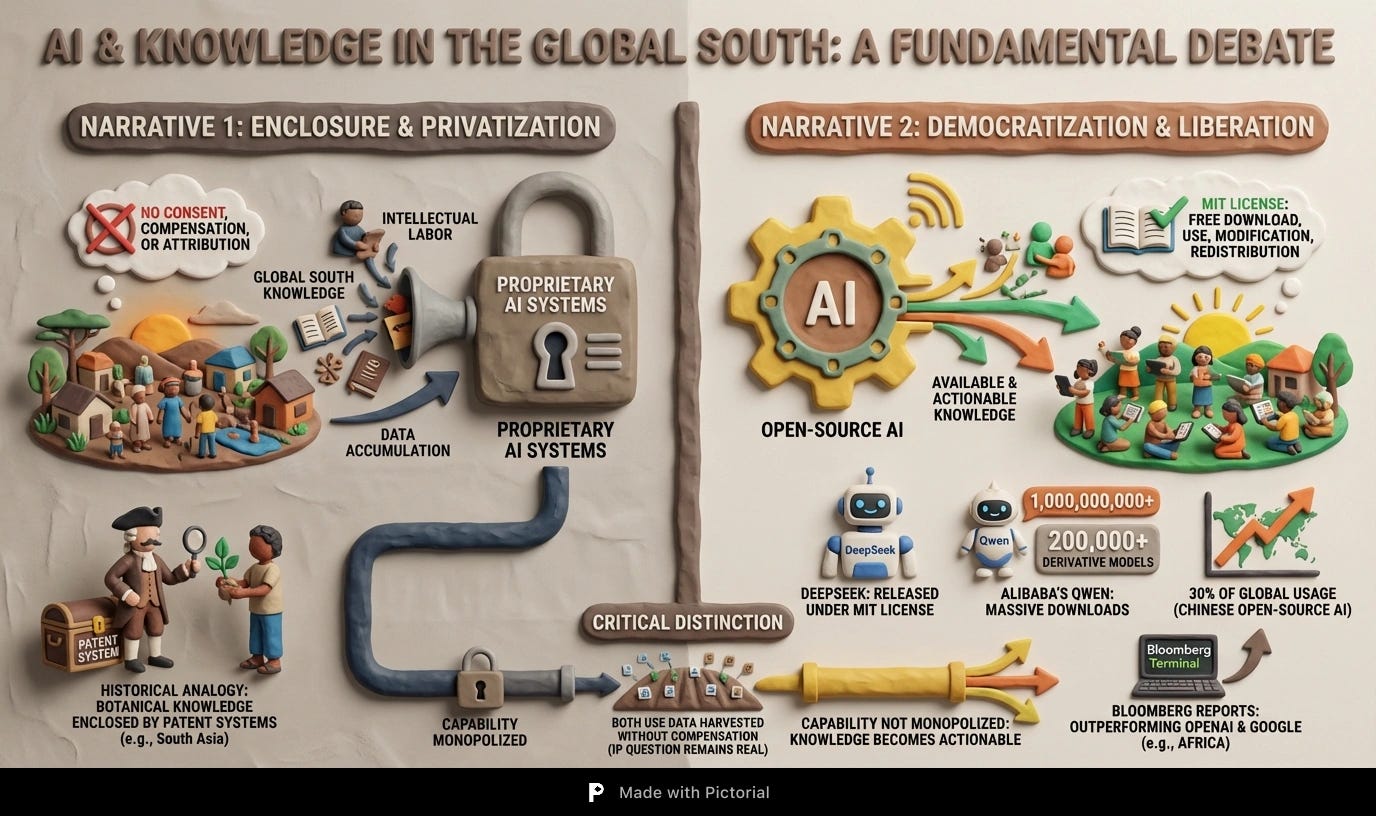
In a recent article published by the Centre for Social Research in Dhaka, S.K. Das and A. Borhan offer a dialectical political economy analysis of artificial intelligence and labor. Their central thesis builds to a striking claim: “All of this has been absorbed into proprietary AI systems without consent, compensation, or attribution. The intellectual labour of the world’s population has been privatised through the accumulation of data, just as the botanical knowledge of South Asian communities was privatised through the patent system.” It is a powerful sentence. It deserves a serious response.
Das and Borhan are not wrong to raise concerns about AI training data and intellectual property. The question of how collective human knowledge is harvested to build commercial AI systems is a legitimate one, and scholars of the Global South are right to ask it. But their narrative tells only half the story. The half they leave out happens to be the half that the Global South most urgently needs to hear.
Arguing with Ghosts
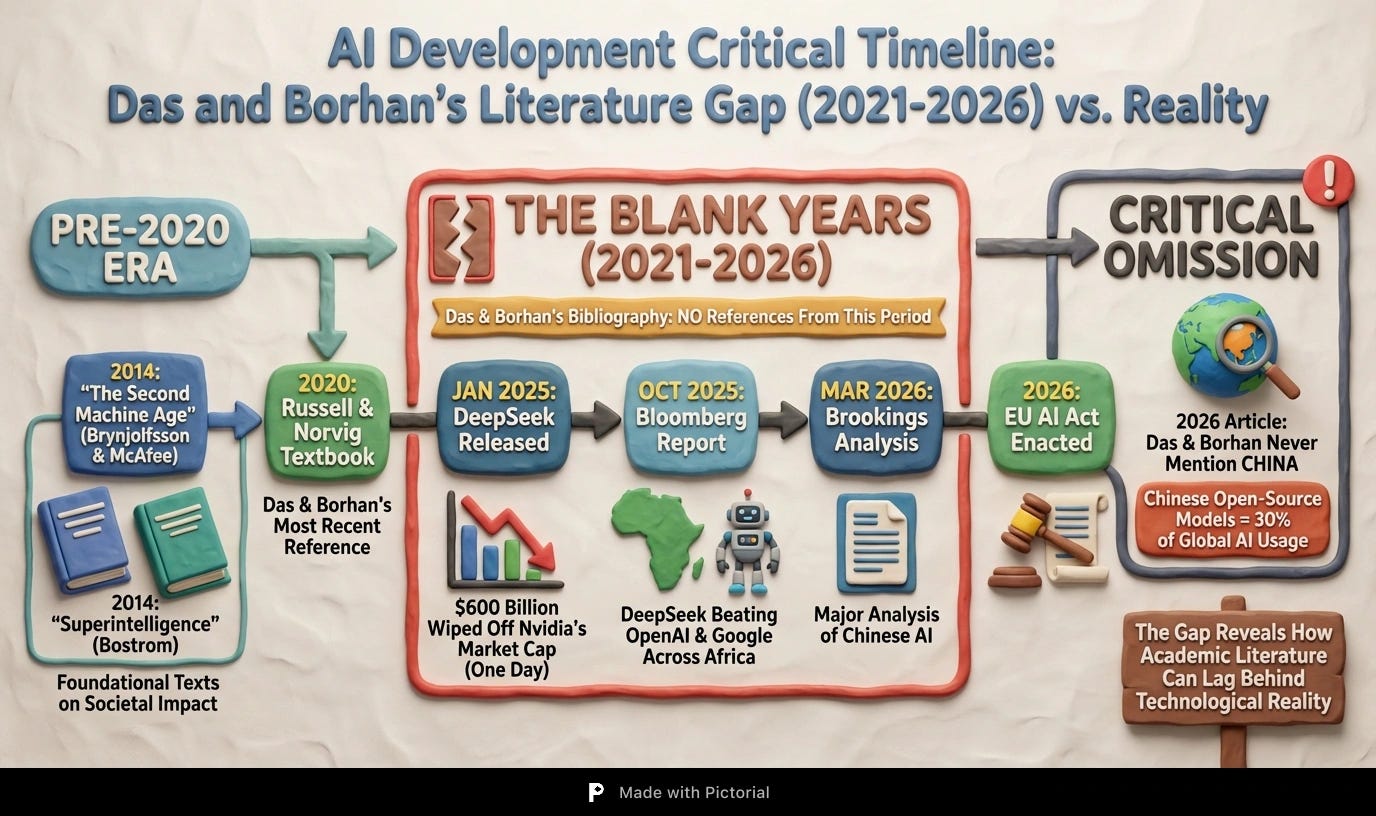
The first problem is methodological. Das and Borhan announce that they are challenging “a widely circulated narrative” that “AI will surpass human intelligence and render large sections of humanity economically obsolete.” They cite three books in support: Brynjolfsson and McAfee’s The Second Machine Age (2014), Russell and Norvig’s Artificial Intelligence: A Modern Approach (2020), and Bostrom’s Superintelligence (2014). But none of these works actually advances the extreme position Das and Borhan claim to refute. Brynjolfsson and McAfee analyze structural economic shifts, not human obsolescence. Russell and Norvig wrote a university textbook. Bostrom conducted a philosophical thought experiment about hypothetical superintelligence. Das and Borhan are constructing a ghost army and then heroically defeating it.
The deeper issue is temporal. Their article contains fourteen references. The most recent dates from 2020 — a textbook. From 2021 to 2026, a period in which AI underwent its most dramatic transformation in history, their bibliography is blank. They appear unaware that DeepSeek exists — the open-source model whose release in January 2025 wiped nearly six hundred billion dollars off Nvidia’s market capitalization in a single day. They do not mention that Chinese open-source AI models now account for thirty percent of global AI usage. They have nothing to say about the EU AI Act. And in 2026, in an article about artificial intelligence, they do not mention China. Not once.
Their entire argument rests on the premise of “proprietary AI systems.” But what about open-source AI? If Das and Borhan do not know that open-source models are being downloaded and deployed by millions of users across every continent, then their narrative is not merely incomplete — it is built on a foundation that no longer exists. Let us look at what they missed.
The Half They Didn’t See
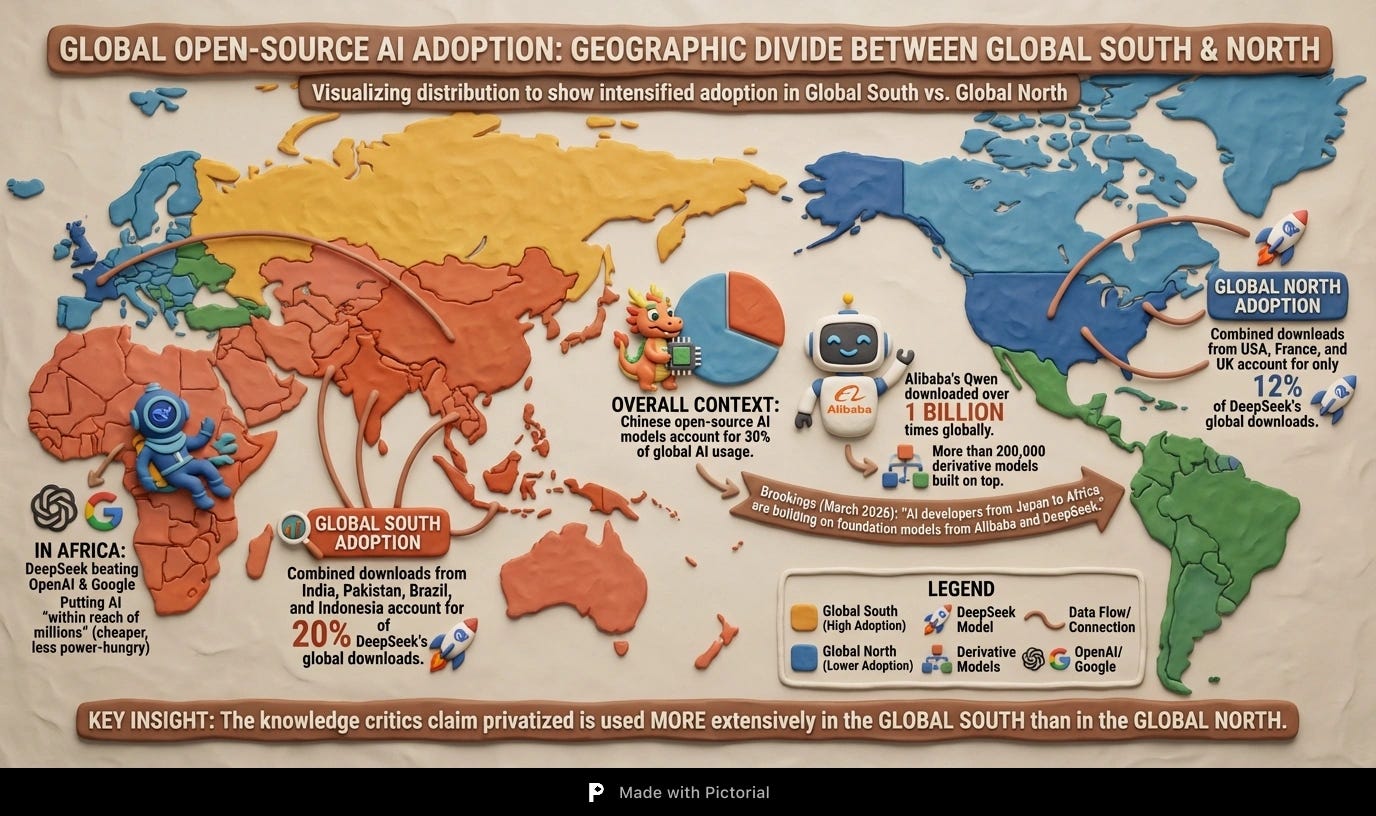
Consider what the world actually looks like. DeepSeek’s R1 model was released under the MIT License — meaning anyone on Earth can download, use, modify, and redistribute it, free of charge. In five benchmark tests, it outperformed OpenAI’s o1 in four, at a reported training cost of approximately six million dollars — a fraction of the hundred million or more spent by its American competitors. Alibaba’s Qwen has been downloaded over one billion times with more than two hundred thousand derivative models built on top of it. This is not the picture of knowledge being locked away. It is knowledge being set free.
The geography of adoption tells its own story. Among DeepSeek’s global downloads, the combined share of Global South countries — India, Pakistan, Brazil, Indonesia — reaches twenty percent. The combined share of major Global North nations — the United States, France, the United Kingdom — is twelve percent. Bloomberg reported in October 2025 that DeepSeek was beating OpenAI and Google across Africa. As Bloomberg put it: “By making AI cheaper and less power-hungry, DeepSeek has put the technology within reach of millions of people.” The knowledge that Das and Borhan say has been privatised is being used, right now, more extensively in the Global South than in the Global North.
But the transformation runs deeper than access. AI has not merely made knowledge accessible — it has made knowledge operable. For the Global South, this distinction matters enormously. The problem was never simply that information did not exist. The problem was that the capacity to turn information into analysis, strategy, and action was monopolized by institutions in the Global North — their universities, their consulting firms, their research foundations.
Consider one example. An African country required a comprehensive country study — the kind of deep political-economic analysis that, until very recently, only a handful of global consulting firms or elite universities had the capacity to produce. It required world-class academic training, substantial funding, and teams of research assistants. Today, a local cadre with a solid basic education can use AI-assisted research frameworks to produce a study of comparable depth and rigor. The knowledge that was once merely available in libraries and databases has become something a person can actually use — not just read, but act upon.
Or consider a progressive television station in Africa, one that serves as a voice for working-class communities. Through AI training, its journalists began to see the possibility of producing the kind of multi-format analytical content — articles, research briefs, crisis analyses — that previously only outlets with BBC- or CNN-level resources could manage. They have not fully achieved this yet. But they can see the path, and they are walking it.
So when Das and Borhan write that “the intellectual labour of the world’s population has been privatised,” they are pointing to a real tension. But it is only half the picture. These cases — and they are far from unique — reveal a simultaneous and equally powerful trajectory: knowledge is also being democratized, and it is being democratized precisely among the communities that Das and Borhan claim to speak for. To be clear, the concern about AI training data is not without merit. Open-source models, too, are trained on data harvested without compensation. That intellectual property question remains real. But the critical distinction is this: open-source AI ensures that the capability itself is not monopolized. The problem with Das and Borhan’s narrative is not that their worry is groundless — it is that their story is so partial as to be misleading.
The Cost of Pessimism
Das and Borhan position themselves as advocates for the Global South. Yet their article does not contain a single concrete example from the Global South — no case study, no data point, no voice from the communities they purport to represent. Meanwhile, those communities are not waiting for permission.
Brookings, in a March 2026 analysis, noted that “AI developers from Japan to Africa are building on foundation models from Alibaba and DeepSeek. Even in Silicon Valley, Chinese open-source models are gaining traction.” CSIS titled its own report on the subject “An Open Door: AI Innovation in the Global South” — a striking contrast to the enclosure narrative that Das and Borhan advance. And Amandeep Gill, the United Nations Secretary-General’s Special Adviser on digital technologies, offered a pointed historical warning: “We’ve seen this story before, during previous industrial revolutions, when those who missed steam power found themselves 50 years behind in terms of development. We cannot afford to let that happen again.”
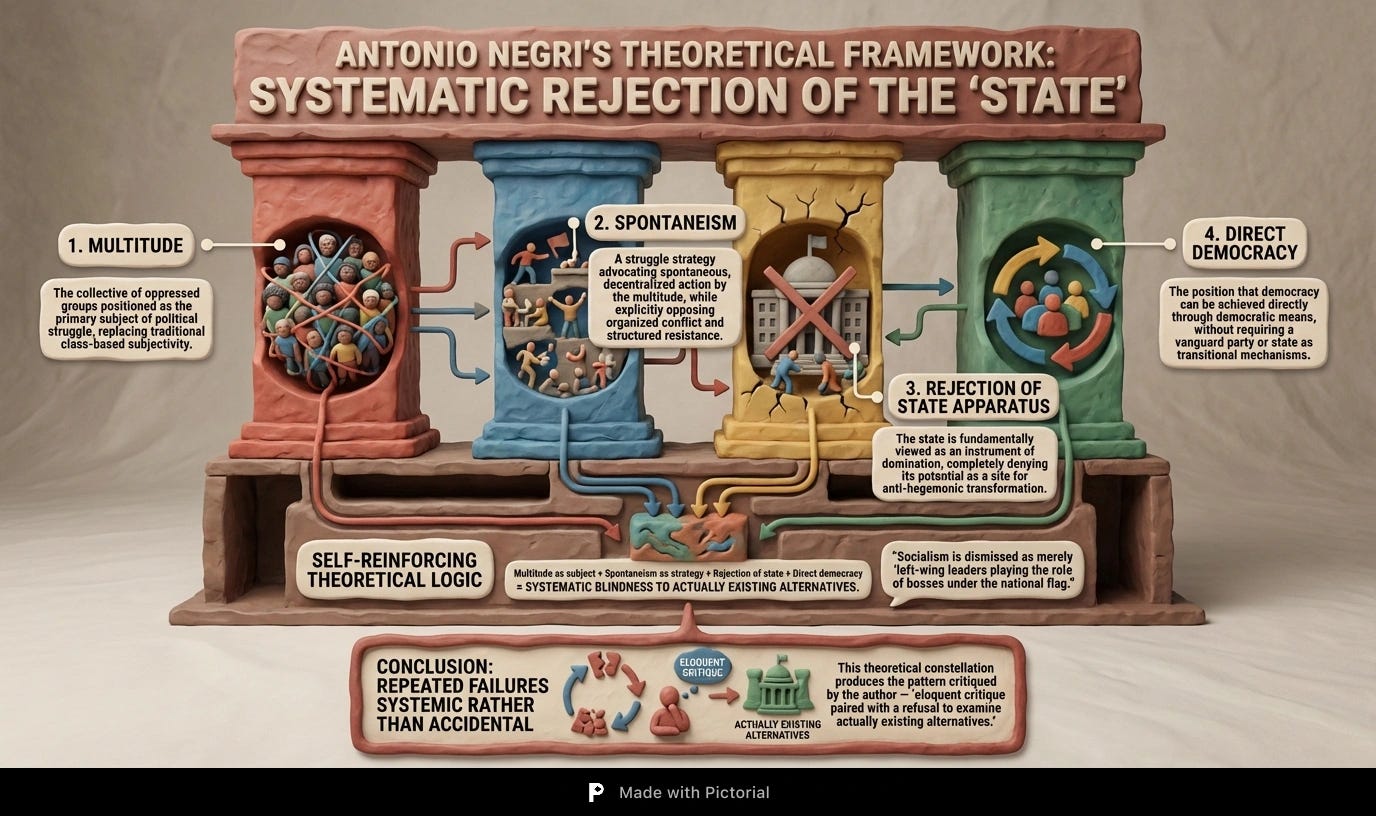
Das and Borhan’s proposed solutions — public ownership of AI, democratic governance of data resources, legal recognition of collective knowledge — are not wrong in principle. The problem is that these are not hypothetical aspirations waiting to be debated. China — itself a member of the Global South — has already classified data as a factor of production, built a systematic AI governance framework, and fostered the open-source ecosystem that now accounts for thirty percent of global AI usage. Scholars who claim to speak for the Global South yet refuse to examine what a fellow Global South country has actually accomplished are not engaging with reality. In 2026, discussing AI governance without mentioning China is simply not a serious conversation. I have argued elsewhere, in a peer-reviewed article published in the MGIMO Review of International Relations, that this pattern — eloquent critique paired with a refusal to examine actually existing alternatives — is endemic to a certain strand of Western left theory, and that its repeated failures are systemic rather than accidental. Interested readers may find that argument in “Beyond the Multitude.”
We are pursuing a different path. Across the Global South, we are working with researchers, journalists, and movement cadres to build their own AI-powered research systems — systems where the machine handles the mechanical labor of searching, summarizing, and formatting, while humans retain full control over judgment, interpretation, and direction. The goal is not to reject Northern technologies but to help Global South organizations move from being passive consumers of AI to being builders of their own tools, embedding their own methodologies, serving their own agendas. The correct response to AI is not lamentation. It is learning to use it, and then learning to build with it.
Knowledge Unbound
Das and Borhan’s concerns are not fabricated from nothing. But they saw only half the picture, and the half they missed is the half that matters most. Their article reads, in fact, rather like a severely hallucinating AI — knowledge base frozen at 2020, no field research conducted, no engagement with the communities it claims to serve, generating analysis that sounds plausible on the surface but is disconnected from the world as it actually exists. The real risk for the Global South is not artificial intelligence itself. It is the risk of missing a historic window of opportunity while paralyzed by narratives that mistake a fraction of the truth for the whole of it.
If Das and Borhan had used AI to assist their research, they would at least not have published a bibliography that stops at 2020. More importantly, if they had experienced firsthand what AI can do — if they had seen a local cadre produce a world-class country study, or watched a progressive newsroom discover capabilities it never imagined — they would understand why the Global South should embrace this technology. Knowledge is being unbound. The question is not whether to engage, but how quickly and how wisely. Das and Borhan might consider starting with a small step: use some AI.
Jeff, very solid piece. "Knowledge Unbound" puts into sharp focus something that urgently needed to be said.
The core argument is precise and necessary: a critique of data extractivism that ignores the actual existence of open source as a global phenomenon is not merely an empirical oversight — it is a form of theoretical paralysis with concrete political consequences for the Global South.
The observation about Das and Borhan's bibliography frozen at 2020 deserves even stronger emphasis: when it comes to AI, temporal bias is not a minor methodological flaw — it is a disqualifying one. No serious analysis of artificial intelligence can be built on a knowledge base that predates the very transformations it claims to explain. A bibliography that stops before DeepSeek, before the EU AI Act, before the Chinese open-source ecosystem reached thirty percent of global usage, is not simply incomplete — it is analyzing a world that no longer exists. And in the Global South, where the window of opportunity is narrow and the cost of missing it is measured in decades, outdated analysis is not just academically weak. It is politically dangerous.
This connects directly with Yuk Hui's call for technodiversity: there is no single technological path, and assuming that all AI equals privatization amounts to denying the very possibility that the Global South can build its own tools on its own terms. Das and Borhan's framework forecloses precisely what it should be demanding — alternative technological futures rooted in different political and epistemic conditions.