Factory-Free Manufacturing
A Mountain County's Bet on AI Drama

On April 17, 2026, inside the broadcast hall of the Cun Chao Journey Museum in Rongjiang County, Guizhou Province, nearly two hundred people gathered for a training session unlike anything the building had hosted before. They were inheritors of intangible cultural heritage—masters of indigo dyeing, silver jewelry crafting, and traditional embroidery. They were young people who had returned from factory jobs in coastal cities, drawn back by the digital buzz surrounding their hometown. And they were village livestreamers who had spent years learning to sell local products through short videos on Douyin and Kuaishou. What they were learning that day, however, was none of those things. They were learning to use artificial intelligence to produce animated short dramas—a format known in China as manju, or AI-powered comic drama. Over the course of the day, they practiced turning Dong ethnic folktales into scripts, generating character designs from Miao textile patterns, and composing animated scenes from descriptions of village festivals, all with AI tools that required no drawing skills and no animation experience.
Rongjiang is a small, ethnically diverse county nestled in the mountains of southwestern China, home to 385,000 residents spread across sixteen ethnic groups, with ethnic minorities comprising over 80 percent of the population. It was among the last batch of counties in the entire country to be lifted out of extreme poverty—a distinction that tells you something about both its remoteness and the depth of its historical disadvantage. Its GDP in 2023 was 9.587 billion yuan, roughly 1.3 billion US dollars. Yet this county is now stepping into a market that reached nearly 20 billion yuan in 2025 and is projected to exceed 85 billion by 2030.
This sounds like a story about manufacturing—something scalable, tradable, capable of creating employment. And in a sense, it is. But this particular form of manufacturing requires no factories, no supply chains, no ports. All it takes is a computer and an internet connection.
The Cost Collapse
The numbers tell a stark story of collapse—the kind that changes who can participate in an industry. Traditional animation production in China costs between 10,000 and 100,000 yuan per minute, depending on quality, and takes one to two years to complete a standard 24-episode series. A single series can cost 15 million yuan or more. AI-powered drama has compressed those figures to a degree that would have seemed implausible just two years ago: production costs drop to 500 to 5,000 yuan per minute—a reduction of more than 90 percent—while a comparable series can be finished in one to one-and-a-half months, a compression of more than 95 percent. A short-drama-length AI production, the kind that runs on mobile platforms, can be completed in one to four weeks by a team of just a few people for as little as 50,000 yuan. The economics that once confined animation to well-capitalized studios in Beijing, Shanghai, and Shenzhen have been fundamentally upended.
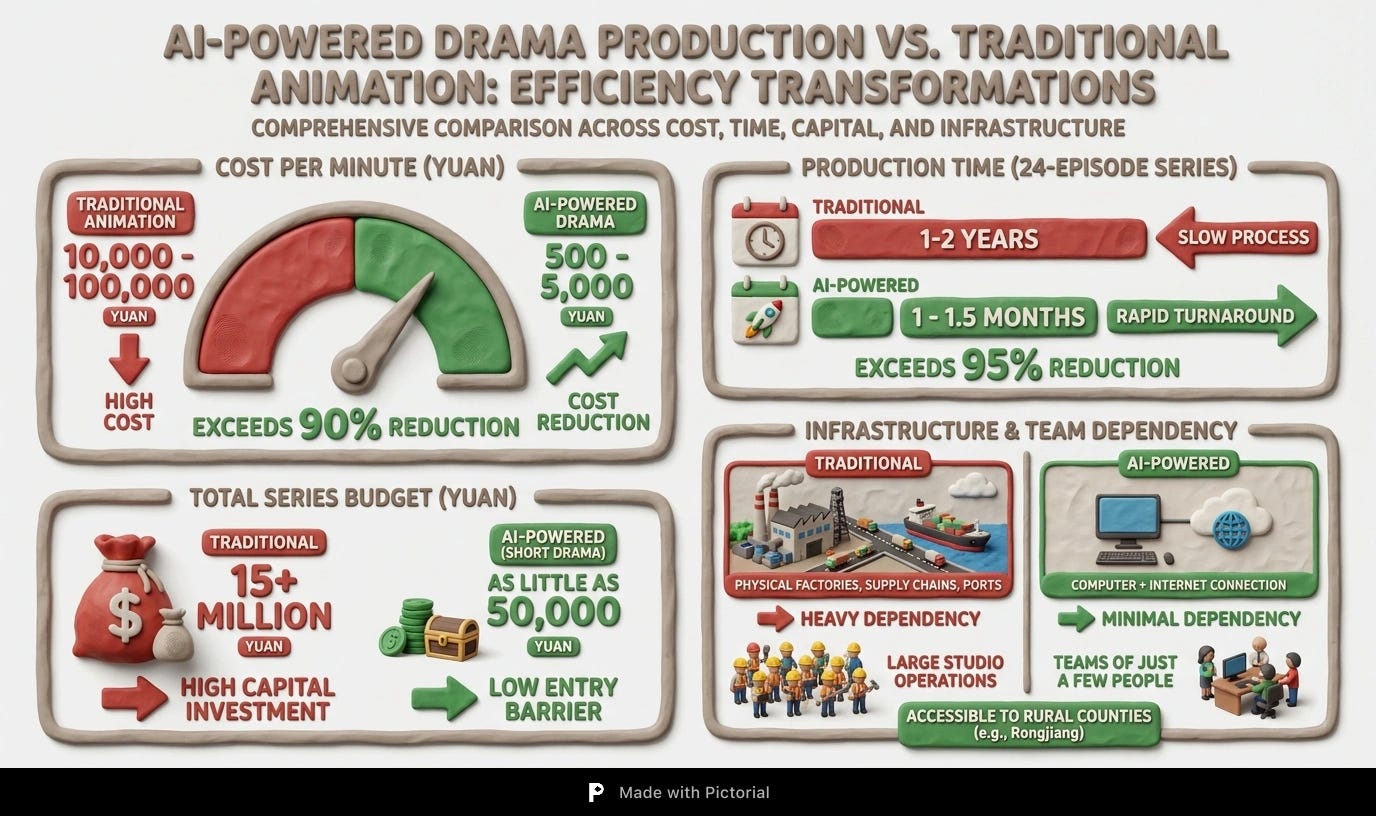
Consider what it takes to start a traditional manufacturing operation: a factory building, production equipment, raw material supply chains, logistics infrastructure, proximity to ports or highways. The capital requirement typically runs into tens of millions of yuan—often hundreds of millions. Now consider what it takes to start an AI drama operation: a decent computer and a broadband internet connection, for a few thousand yuan. The critical difference is not in the act of production itself but in the infrastructure dependency. A mountain county may lack a highway logistics hub and may be a thousand kilometers from the nearest deep-water port, but as long as there is network coverage, it can participate in this form of manufacturing. Guizhou Province has extended 5G coverage to 89 percent of its administrative villages, which means the basic connectivity condition is met even in relatively remote areas. This infrastructure independence explains why the technology permits such an experiment. But it does not explain why Rongjiang, specifically, has seized the moment.
What Rongjiang Already Has
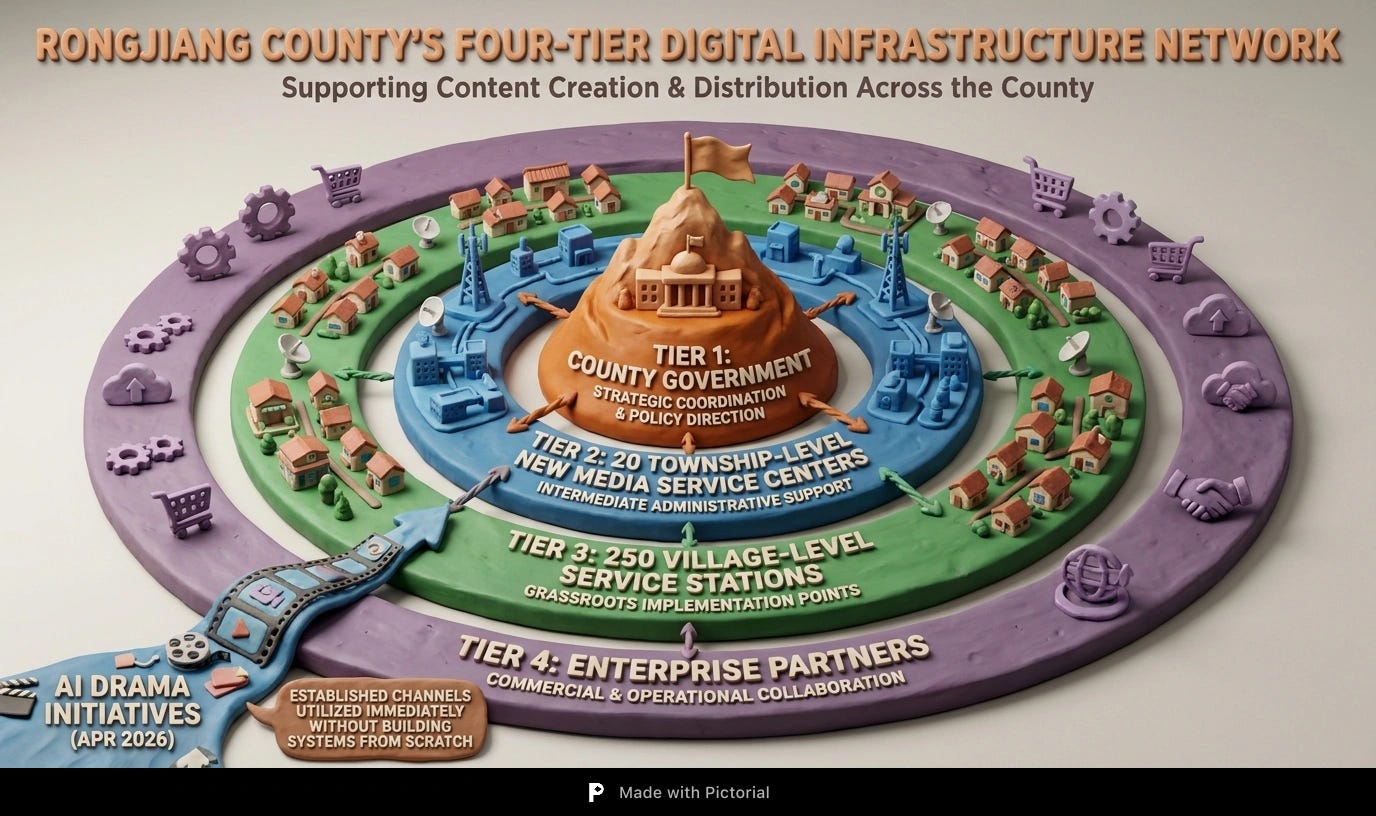
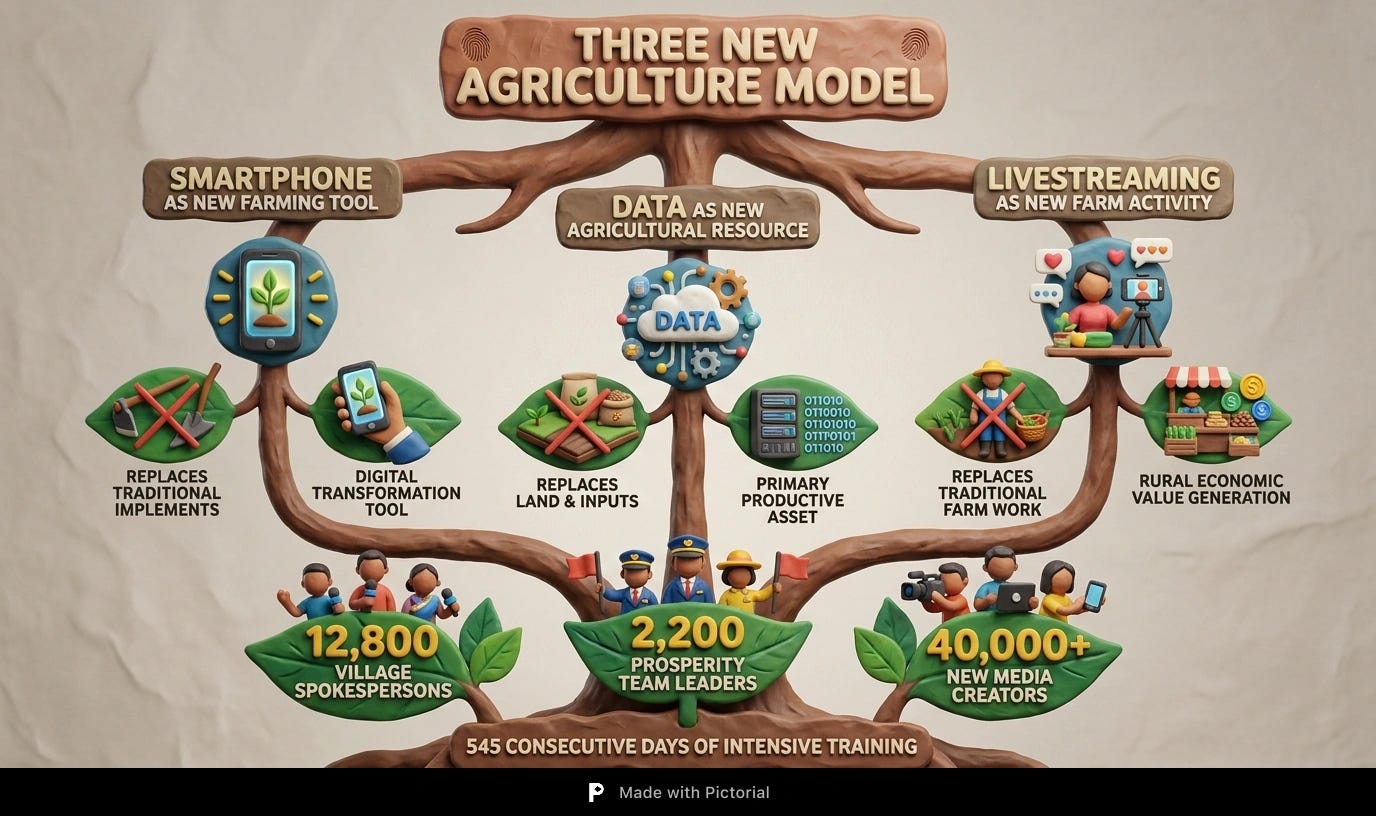
The answer lies in what Rongjiang had already built before AI drama entered the picture. Since 2021, the county had been pursuing a strategy it calls the “Three New Agriculture” model: making the smartphone into a new farming tool, data into a new agricultural resource, and livestreaming into a new farm activity. Through 545 consecutive days of intensive, hands-on training—sessions held in village squares, township centers, and makeshift classrooms—Rongjiang had cultivated 12,800 village spokespersons, 2,200 prosperity team leaders, and more than 40,000 new media creators. A four-tier network—spanning the county government, its 20 township-level new media service centers, 250 village-level service stations, and enterprise partners—had been established to support digital content creation and distribution. When AI drama arrived in April 2026, it did not need to build its delivery system from scratch. It simply flowed into pipes that were already laid.
Beyond human infrastructure, Rongjiang possessed something no AI studio in a major city could replicate: cultural raw material of extraordinary specificity and richness. The Cun Chao (Village Super League), a grassroots football tournament that began in 2023 and captured the nation’s imagination, had generated over 280 billion online views across China’s major social media platforms. The county’s sixteen ethnic groups—Miao, Dong, Shui, Yao, and others—brought a wealth of folklore, polyphonic choral singing, textile traditions, silver jewelry craftsmanship, and ceremonial practices that had been preserved across centuries. An early experiment confirmed the potential: a short drama featuring Dong ethnic choral singing, known as the “Dong Village Heavenly Sounds,” had already garnered 36 million views online. These were not generic stories that could be produced anywhere. They were place-specific, culture-specific assets—precisely the kind that gain value in a crowded marketplace precisely because they cannot be imitated.
The market dynamics of AI drama made this distinction matter enormously. In 2025, 60,946 AI dramas were released in China. Only 96 of them surpassed 100 million views—a hit rate of 0.16 percent. This brutally low success rate means that formulaic, assembly-line content cannot break through the noise. But the corollary is more interesting: it means that differentiation, not scale, is the primary competitive advantage. Unique local culture is precisely the kind of differentiation that cannot be manufactured in a Beijing studio. A county that knows its own stories, and has people trained to tell them, holds a card that no amount of capital can buy.
Field research in Rongjiang revealed a population whose understanding of AI was far more pragmatic—and more interesting—than many expert discussions suggest. At the county People’s Hospital, AI-assisted chest CT diagnosis had improved efficiency by more than 80 percent, with doctors relying on tools like DeepSeek in their daily practice. At the government service center, a video-based AI system for inspecting food business permit applications—dubbed “cloud inspection”—had compressed what used to take 20 days for 180 temporary stall applications down to roughly two minutes per applicant. Yet a grassroots worker in Chemin Subdistrict offered a sobering counterpoint. AI dependency, he warned, was like an addiction. When several newly hired colleagues used AI to write reports on the same topic, the results were nearly identical—eerie proof that the tool could flatten thinking as easily as it accelerated work. This was not a county drunk on technology hype. It was a county learning to use a powerful tool while keeping its limitations in plain sight.
A Leapfrog for the Global South
In early 2026, the International Association for Press and Communication Development, or IAPC, together with the Global South Academic Forum, organized an international delegation to visit Rongjiang and observe its AI applications firsthand. A Brazilian participant, after spending days touring the county’s new media centers, visiting village livestreaming stations, and watching local creators use AI tools to produce content drawn from ethnic minority traditions, offered an assessment that cut through the usual diplomatic language. This “technology going to the countryside” model, she said, provided “practical reference for Brazil’s own rural digital transformation.” Coming from a practitioner in a Global South country on the other side of the planet, this was not ceremonial praise. It was a specific, grounded recognition that something happening in a small Guizhou mountain county might be directly relevant to communities facing similar challenges across the developing world—places with rich cultural traditions, large rural populations, and a growing digital infrastructure but without the industrial base that traditional development models demand.
This connection between a Chinese mountain county and the broader Global South is not accidental. The Brookings Institution has argued that Global South countries may be able to “leapfrog traditional industrialization stages, moving directly from agriculture- or resource-based economies to digital economies”—skipping the decades-long trajectory of building factories, assembling supply chains, and climbing the value chain step by painful step. The United Nations has called for AI technologies to benefit all countries and communities, not just those that already possess advanced technological capacity, emphasizing three pillars: skills training on a massive scale, localized application adapted to local languages and cultures, and digital public infrastructure that makes tools accessible beyond elite urban centers. Rongjiang’s practice aligns with all three. Its action plan sets a target of training 30,000 AI application champions across the county. Its AI drama initiative is rooted not in generic content but in the stories and aesthetics of local ethnic cultures. And its county-township-village-enterprise four-tier network functions, in effect, as digital public infrastructure at the county level—a lattice through which new technologies can flow without requiring each village to build its own connection from scratch.
The market opportunity that underpins all of this is substantial and far from saturated. AI drama has an estimated 900 million potential overseas users. Chinese-made AI dramas earned 2.38 billion US dollars in international revenue in 2025 alone. The market is projected to grow from 16.8 to 20 billion yuan in 2025 to 85 billion yuan by 2030—a compound annual growth rate of nearly 38 percent. China currently dominates global AI drama production capacity at over 90 percent and holds 88 percent of the global market share. But that dominance also signals opportunity in disguise: a rapidly growing market where differentiated, culturally specific content from other regions could find an audience that generic, mass-produced content cannot reach. The same logic that gives Rongjiang an edge—unique culture as competitive advantage—applies to countless communities across the Global South.
What makes Rongjiang’s approach potentially replicable is not the specific tools or platforms—those are available globally—but the institutional design. Three elements stand out. First, a localized training system that prioritizes breadth over stardom: the 12,800 village spokespersons typically have only a few thousand followers each, yet they generate real income for their communities by selling local products and promoting local tourism. This is not the influencer economy of metropolitan China; it is a distributed, grassroots creator economy built on the logic that many small voices can collectively generate more sustainable value than one big star. Second, a public-ownership brand model: the Cun Chao brand is held by a company that is 100 percent state-owned, while Rongyi, the operating company, is a mixed-ownership enterprise with 49 percent state equity. This means individual creators contribute to and benefit from a collective brand asset, rather than competing in a winner-takes-all attention economy where the top one percent capture most of the value. Third, a focus on content rooted in place rather than in platform trends—stories drawn from the specific textures of local life, not from whatever algorithm happens to be amplifying this week.
Liu Qinlan, one of Rongjiang’s village livestreamers, captures this logic in a single ratio that has become something of a local motto. She spends only 20 percent of her energy on livestreaming and 80 percent on developing and producing her indigo-dyed textile products. Product first, distribution second. It is the inverse of the typical influencer playbook, where the platform is the product and the actual goods are an afterthought. And it is a mindset that transfers readily to AI drama: the creative material—the story, the culture, the specificity—matters more than the algorithm. A community that understands this distinction is already halfway to competing in a content-saturated market.
Stories Good Enough to Sell
The logic chain connecting Rongjiang to the broader Global South is, by now, clear. Technology-driven cost collapse created the conditions for participation. Local culture and institutional design provided the basis for differentiation. A large and growing global market supplies the demand. The significance of AI drama lies not in the popularity of a particular tool but in the reconceptualization of what “manufacturing” can mean: economic activity that is scalable, tradable, and job-creating, no longer dependent on factories and supply chains but on a computer and an internet connection. Across the Global South, in places that have culture, stories, internet access, but no factories, the conditions for direct entry into the digital content economy may exist for the first time.
Grassroots realism tempers the promise. Technology is never a panacea, as Rongjiang’s own officials are the first to acknowledge—the addiction metaphor they use is not rhetorical. The first concrete test of this experiment will come in 2028, when the planned Cun Chao World Cup brings international attention to the county and, with it, a scheduled showcase of AI dramas created by local creators from ethnic minority traditions. Whether those dramas can hold their own in a market flooded with 60,000 competitors remains an open question. But the question itself is already something new: a mountain county without a single factory asking whether its stories are good enough to sell.