Cooling the Machine
China's Quest to Reconcile AI and Nature

Thirty-five meters below the surface of Qingshui Bay, on the southern coast of Hainan province, capsule-shaped data modules sit quietly on the seabed. Seawater flows through radiators on the back of server racks, drawing heat away from processors humming inside. Fiber-optic and power cables run from the modules to a small onshore control station, where fewer than ten staff manage daily operations through intelligent remote systems. Schools of fish gather and circle around the steel hulls, apparently unbothered by their presence. Pilot testing here began in 2023, and the facility has since been expanding module by module, gradually taking on more computing workloads for the Hainan Free Trade Port and telecom operators.
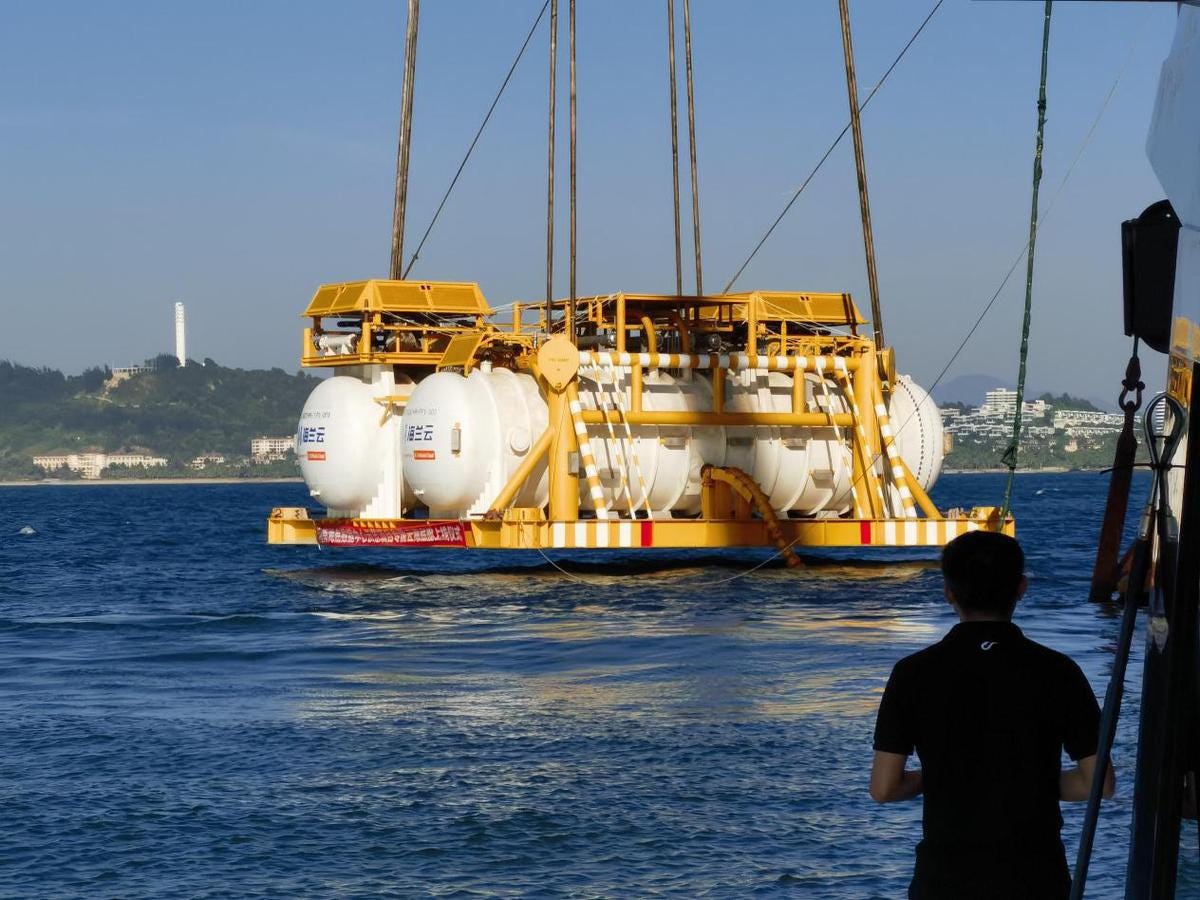
The image is striking because it is so literal. The biggest engineering challenge facing data centers everywhere is heat. Servers run hot, and keeping them cool enough to function reliably consumes enormous volumes of electricity and, in most conventional designs, freshwater. As AI drives a global surge in demand for computing power, that cooling burden is growing fast. China is not the only country grappling with this, but the combination of policy mandates, strategic planning, and hands-on experimentation visible along its coast and across its western plateaus makes it a particularly instructive case for any nation now laying the foundations of its digital infrastructure.
What AI Costs in Energy and Water
The raw numbers command attention. In 2024, the world’s data centers consumed roughly 415 terawatt-hours of electricity, about 1.5 percent of global generation and more than the entire annual power consumption of Thailand. The United States accounted for 45 percent of that total. China was second at roughly 25 percent, or around 104 terawatt-hours. Water use is harder to pin down but no less significant: China’s data centers drew an estimated 1.57 billion cubic meters of water in 2022, representing about 2.7 percent of national water consumption. Carbon emissions from Chinese data centers are on track to reach 1 percent of the country’s total by the end of 2025. Projected forward, data center electricity demand in China could reach 400 to 600 terawatt-hours by 2030.
Those absolute figures are alarming at first glance. They become more nuanced in proportion. Data centers currently use between 0.9 and 2.7 percent of China’s total electricity, depending on the estimate. For comparison, China’s manufacturing sector added 300 terawatt-hours of new electricity demand in 2024 alone, a single-year jump that Bloomberg noted was more than ten times what data centers consume in total. The International Energy Agency has calculated that data centers account for just 3 percent of China’s new electricity demand since 2022. Industry, electrification of heating, and transport are all far larger drivers.
Proportion does not mean the problem is small. It means the question shifts from “How do we stop AI from consuming everything?” to something more useful: “Can a country put the right rules and incentives in place while the sector’s share of national resources is still manageable?” That question of timing, of acting before the boom rather than after it, is where the most interesting differences between countries emerge.
Two Paths on a Warming Planet
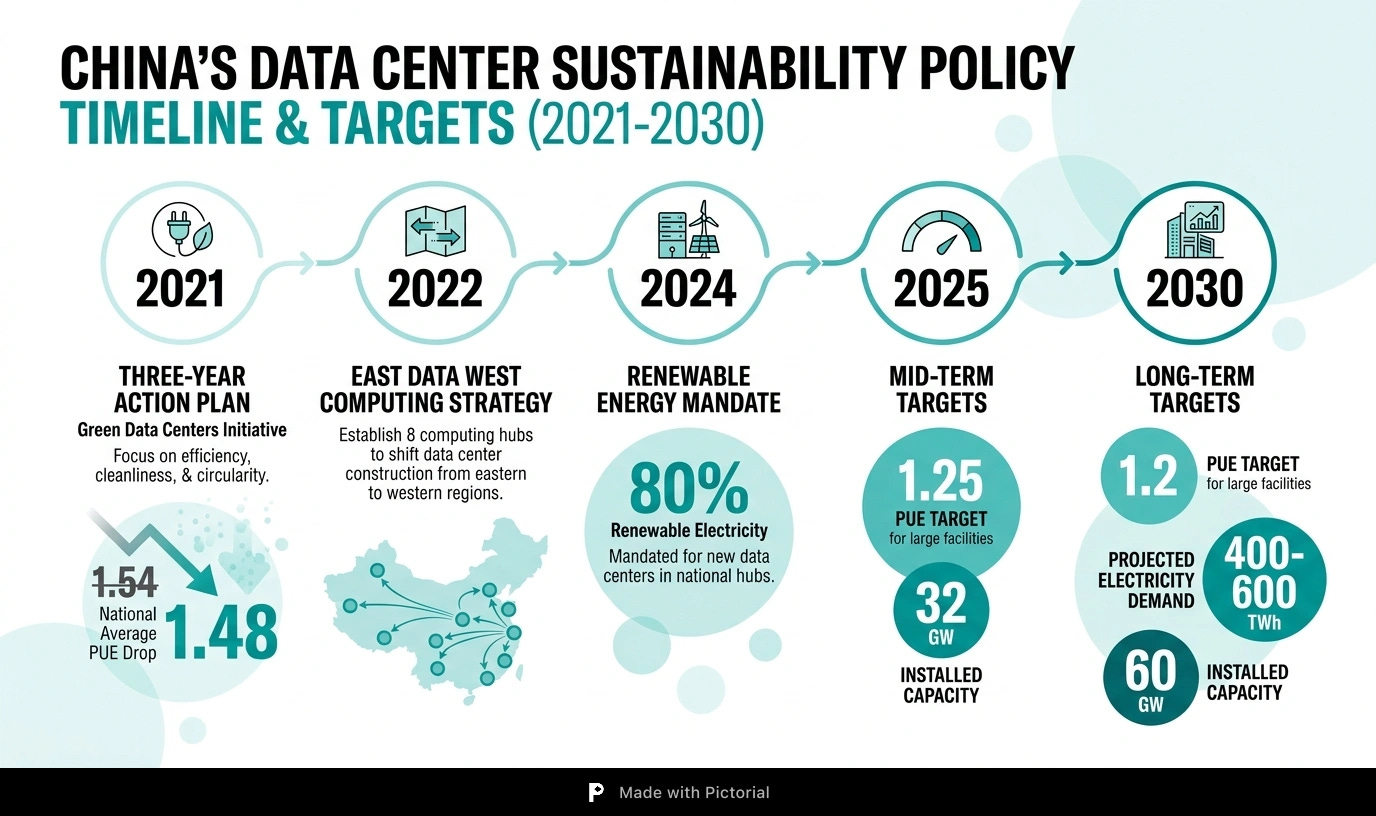
China began moving in 2021 with a three-year action plan to build “green data centers” that are efficient, clean, and circular. The national average PUE, or Power Usage Effectiveness, dropped from 1.54 to 1.48 by the end of the plan. PUE is a standard industry metric: it measures the ratio of total energy a data center uses to the energy actually delivered to its computing equipment. A PUE of 1.0 would mean zero overhead, with every watt going to computation. Most traditional data centers hover around 1.5 or higher. China’s target for large facilities is 1.25 by 2025 and 1.2 by 2030.
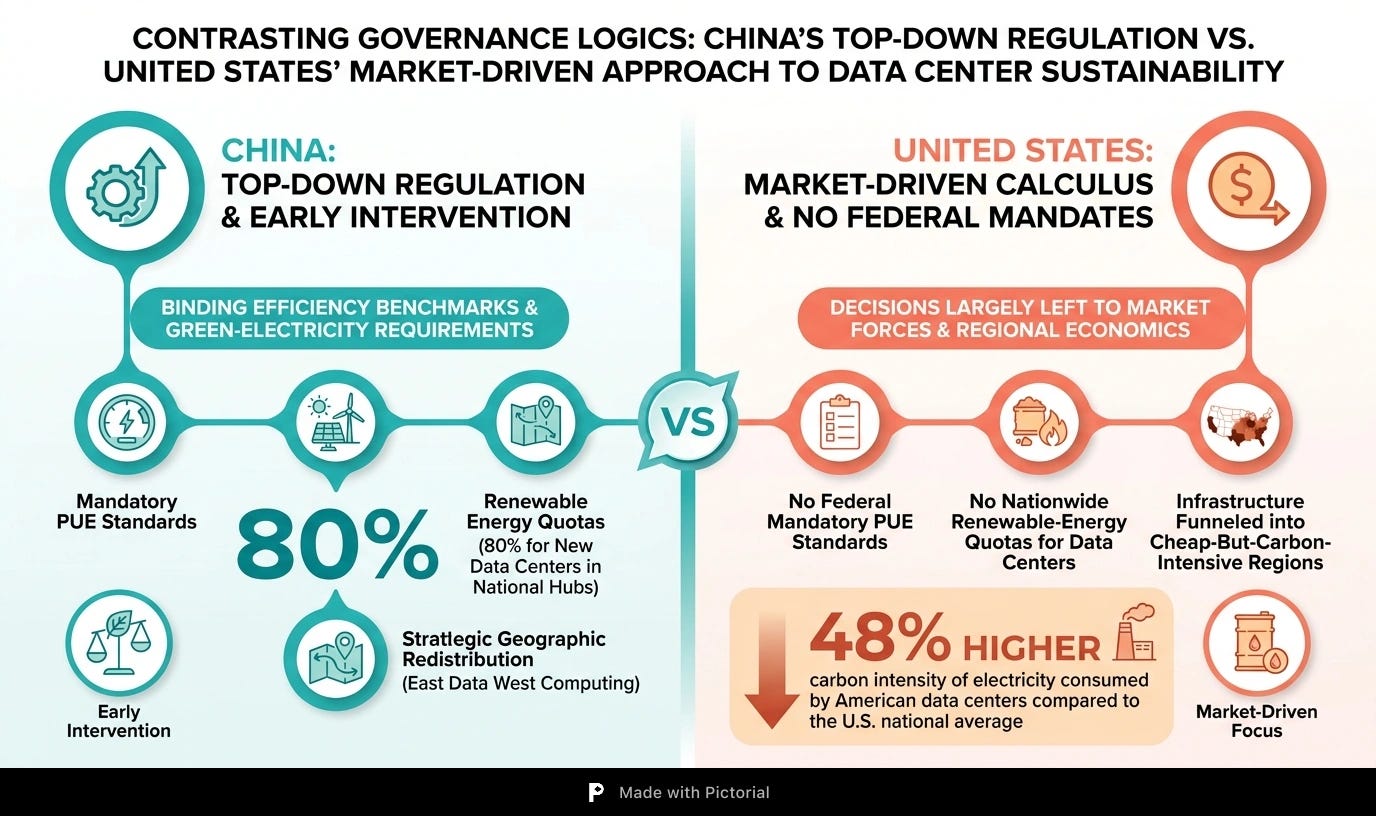
The following year, 2022, China launched “East Data West Computing,” a national strategy to shift new data center construction from the crowded, coal-dependent eastern seaboard to western regions where solar and wind capacity is abundant. Eight major computing hubs were established, with clusters emerging in places like Ulanqab in Inner Mongolia, where companies including Huawei, ByteDance, and 21Vianet have secured around 10 gigawatts of projects. In 2024, the National Development and Reform Commission issued a special action plan requiring all new data centers in national computing hubs to source at least 80 percent of their electricity from renewable energy. More than 50 data centers nationwide had met the green-energy standard as of the latest reporting. Western regions, historically poorer and less developed, gain investment, jobs, and a new role in the national digital economy.
The United States presents a striking contrast. American data centers consume 45 percent of the global total, nearly twice China’s share, and account for 4.4 percent of U.S. electricity. That share is projected to rise to between 7 and 12 percent by 2028, according to the MIT Technology Review. A 2025 investigation by the same publication found that the carbon intensity of electricity consumed by American data centers is 48 percent higher than the U.S. national average. The reason is geographic: clusters have concentrated in areas with cheap but carbon-heavy grids, particularly the coal-dependent mid-Atlantic region. In Virginia, a 2024 state legislature report estimated that average residential ratepayers pay an additional $37.50 per month to cover data center energy costs. At the federal level, there are no mandatory PUE standards and no nationwide renewable-energy quotas for data centers.
Two governance logics, then, are visible. China chose to regulate early and from the top down, setting binding efficiency benchmarks and green-electricity requirements while data centers still represent a thin slice of national demand. The United States has largely left the calculus to the market, and the market has funneled infrastructure into regions where power is cheap but dirty.
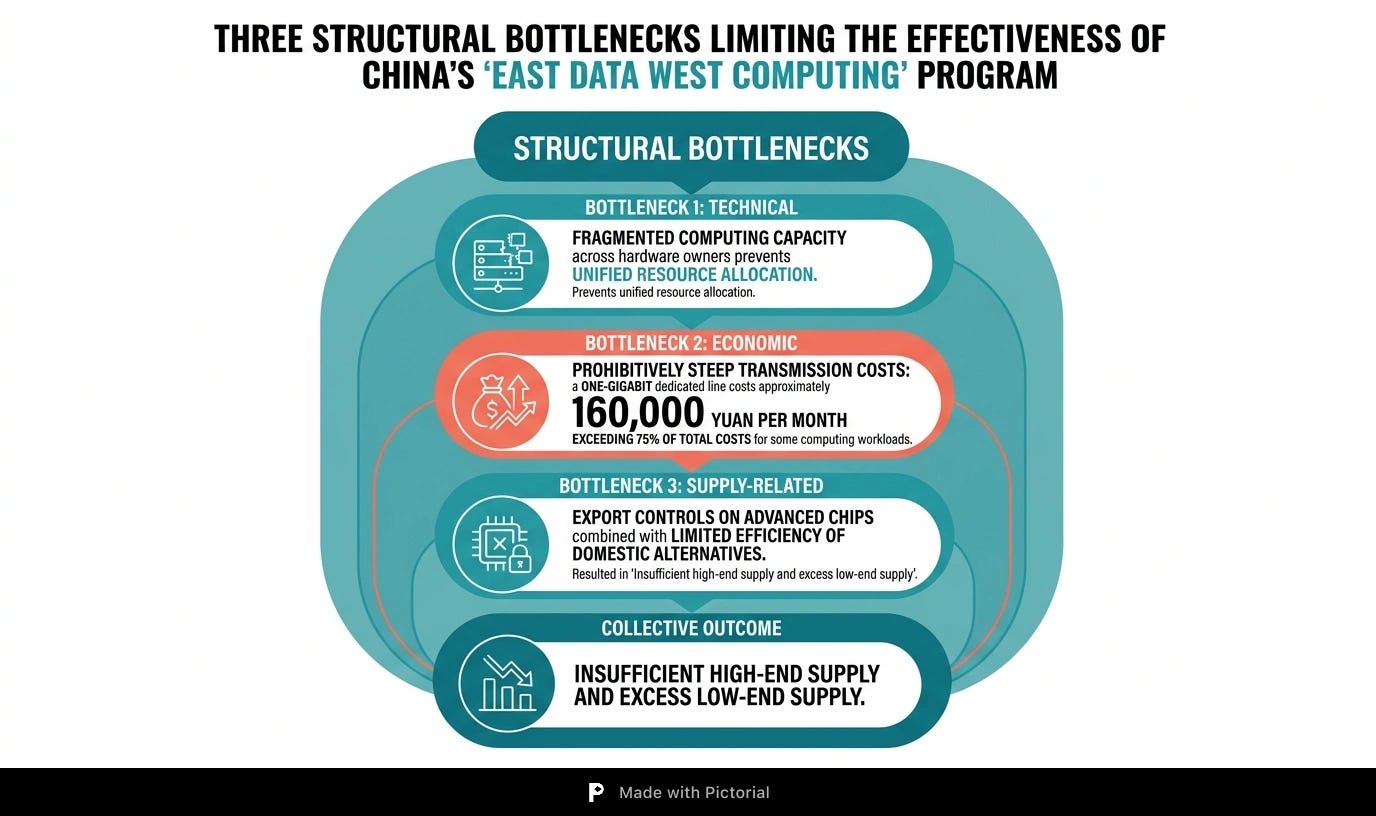
Yet China’s record is far from spotless. A 2025 study by Wang Lining of the Qinghai Academy of Social Sciences and Jiang Jing of Nanjing University’s Yangtze River Industrial Research Institute identifies serious gaps between policy ambition and on-the-ground reality. Consider the green-electricity question. The 80 percent renewable target applies specifically to new data centers built inside national computing hubs. Across the entire existing fleet, however, renewable energy accounts for only about 28 percent of data center power. The most computing-hungry provinces, clustered in the east, have renewable shares below 20 percent, and green certificates purchased by the computing industry represent less than 5 percent of the national total. The gap is not between a target and its own outcome — it is between the standards being set for new construction and the much dirtier reality of the data centers already running. The researchers also document what they call three bottlenecks in the “East Data West Computing” program. First, computing capacity that cannot be unified across different hardware owners. Second, transmission costs so steep that a one-gigabit dedicated line runs about 160,000 yuan per month, exceeding 75 percent of the total cost for some computing workloads. Third, export controls on advanced chips and the limited efficiency of domestic alternatives, leaving “insufficient high-end supply and excess low-end supply.” These are not minor caveats. They are structural frictions that any country will encounter when ambitious policy meets physical and economic constraints.
The Ocean as a Cooling Tower
The tension between aspiration and difficulty is visible again beneath the waters off Hainan. The Lingshui facility sits within a natural upwelling zone where coastal water temperatures stay below 24.5 degrees Celsius year-round, providing a free and consistent cold sink. Seawater is pumped through radiator-style heat exchangers attached to server racks, a process that replaces the energy-intensive chilled-water systems used in conventional data centers. The engineering is led by Highlander, a marine technology firm, with fiber-optic cables supplied by national champions such as Zhongtian Technology and Hengtong Group.
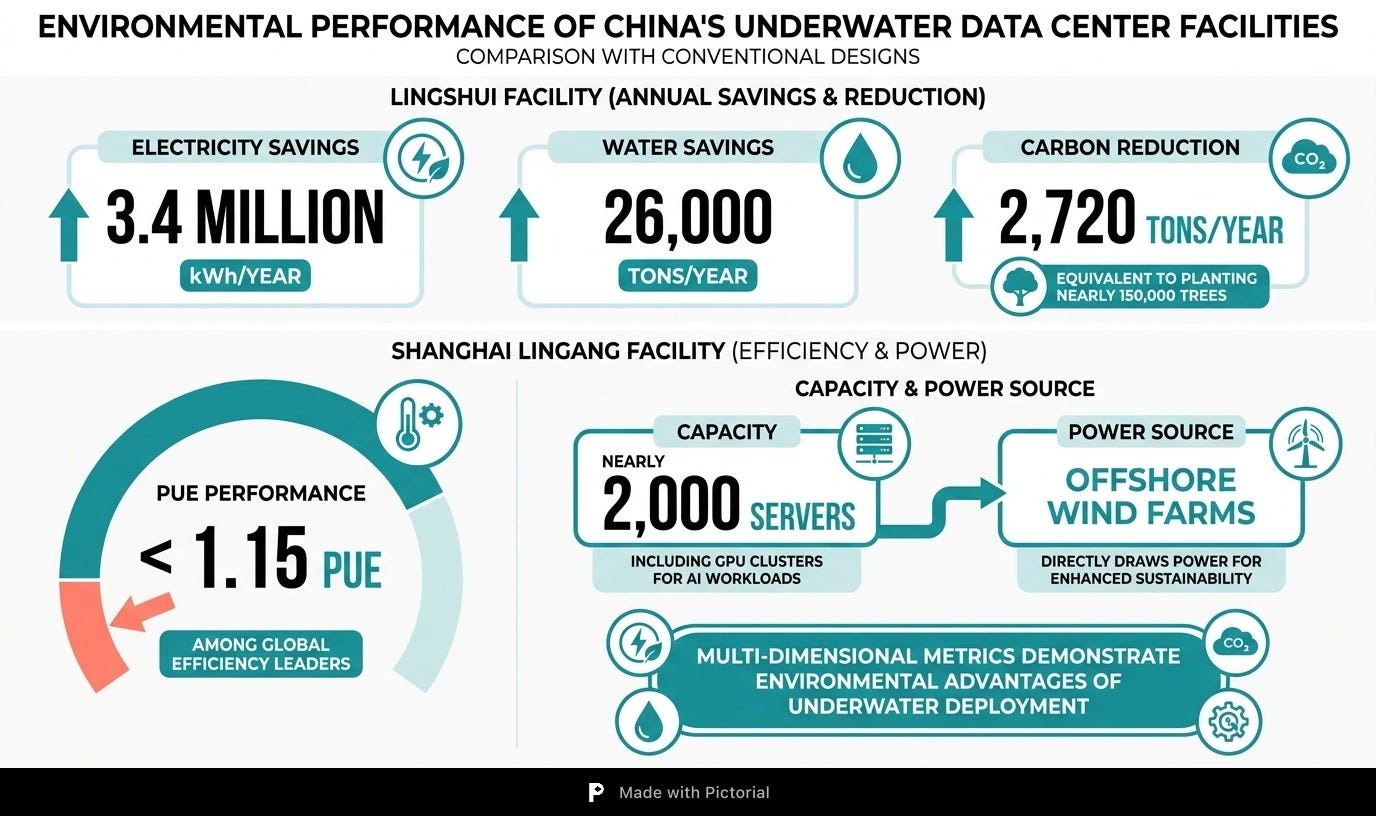
According to the operator, at full capacity the Lingshui facility could save 3.4 million kilowatt-hours of electricity and 26,000 tons of water per year, while reducing carbon emissions by approximately 2,720 tons, equivalent to planting nearly 150,000 trees. These figures, it must be noted, are theoretical projections based on full-load operation, not verified performance data. The operator’s own monitoring shows that seawater temperature within a two-meter radius of the modules rises by less than one degree Celsius after heat exchange, less than the warming caused by an hour of midday sunlight. Marine life appears to gather around the structures, though the significance of this behavior is not well understood.
A second underwater facility is now running. In May 2026, a 24-megawatt underwater data center entered full commercial operation off the coast of Shanghai’s Lingang district. Built at a cost of $226 million through a partnership between the government, China Telecom, and HiCloud Technology, it houses nearly 2,000 servers, including GPU clusters for AI workloads, and draws power directly from nearby offshore wind farms. Chinese media reports claim a PUE below 1.15, placing it among the most efficient large-scale facilities anywhere, though this figure has not yet been independently verified by a third party. Microsoft explored a similar concept with Project Natick, deploying submerged data center capsules in 2018, but ultimately shelved the commercial program. China’s decision to keep pushing the technology forward is itself worth noting.
The unknowns, however, are real. MERICS, a Berlin-based research institute, observes that the environmental impacts of underwater data centers on marine ecosystems “remain understudied,” particularly during ocean heatwaves. Engineering challenges include sealing pressure-resistant modules against corrosive saltwater, ensuring long-term cable reliability, and the fact that maintenance may require lifting entire modules to the surface. These challenges do not invalidate the technology. They simply mean that anyone considering it should approach with open eyes, tracking both the energy savings and the ecological questions that will take years to answer.
For coastal nations in the tropics and subtropics, many of them in the Global South, the core idea is worth watching: using the natural cold of seawater to replace mechanical refrigeration and freshwater cooling. The principle is straightforward, even if the full ecological accounting remains incomplete.
A Window Before It Closes
Data center infrastructure has a design life of five to ten years. The efficiency standards and energy sources chosen when a facility is built will largely determine its environmental footprint for a full decade, because retrofitting cooling systems or switching power contracts mid-life is expensive and technically difficult. Researchers at the China Science and Technology Network have described this as a “lock-in effect”: fail to set the right rules during construction, and the carbon and water costs are locked in until the next equipment cycle.
The world is in the middle of a construction boom. Global data center electricity consumption is projected to rise from 415 terawatt-hours in 2024 to 945 terawatt-hours by 2030, according to the IEA’s central scenario. China’s installed data center capacity is expected to nearly double from 32 gigawatts at the end of 2025 to 60 gigawatts by 2030, growing at 19 percent per year. The window for setting standards is open right now. Once it closes, the cost of correction will be far higher than the cost of getting it right the first time.
China’s experience provides a genuinely useful reference, not because it is a model to copy, but because it is a live experiment with both encouraging results and sobering lessons. The early adoption of mandatory PUE targets and green-electricity quotas shows that regulation before the boom is politically possible. The 28 percent renewable share across the existing fleet shows that even with ambitious standards for new construction, the legacy infrastructure takes a long time to catch up. The transmission bottlenecks, the green-premium costs, the slow development of computing-electricity coordination, these are the kinds of frictions that any country will encounter when policy ambitions run into the physical limits of grids, geography, and capital.
And there is one more dimension. The same AI that drives up energy and water demand is also being put to work on environmental problems. In Jiangsu province, AI-powered acoustic recognition devices deployed at 20 biodiversity observation stations have collected nearly 440,000 data entries covering 243 bird species, reducing labor costs for ecological monitoring by 90 percent. The Ministry of Ecology and Environment is now applying large-model recognition technology to screen trillions of data entries for vehicle emissions fraud, with accuracy rates above 70 percent. This is not a contradiction. It is a reminder that AI is a tool whose environmental ledger depends entirely on how and where it is deployed.
The practical implication for countries now building their digital infrastructure is plain. Set energy-efficiency and renewable-energy standards early, while the concrete is still wet. Track the gap between targets and reality with honesty, not optimism. And learn from the frictions others have already encountered, because the same frictions will appear everywhere. China’s record suggests that early action is possible, that it produces measurable gains, and that it is harder than it looks. That mixture of encouragement and difficulty may be the most honest thing one can say about any country’s attempt to reconcile AI and nature.