Building Intelligence into the Soil
How China's Smart Agriculture Systems Actually Work—From Sensors to Satellites

In the highlands of Yunnan Province, blueberry farmers in Mengzi County face a daily barrage of decisions that can make or break their harvest. When should they water? How much fertilizer should each plant receive? How do they identify the early signs of pest infestation before it spreads? For generations, these questions had only two answers: rely on hard-won experience accumulated over decades, or pay for expensive consultations with agricultural experts whose knowledge resided in thousands of farming manuals—a vast repository of expertise as inaccessible to most farmers as it was comprehensive.
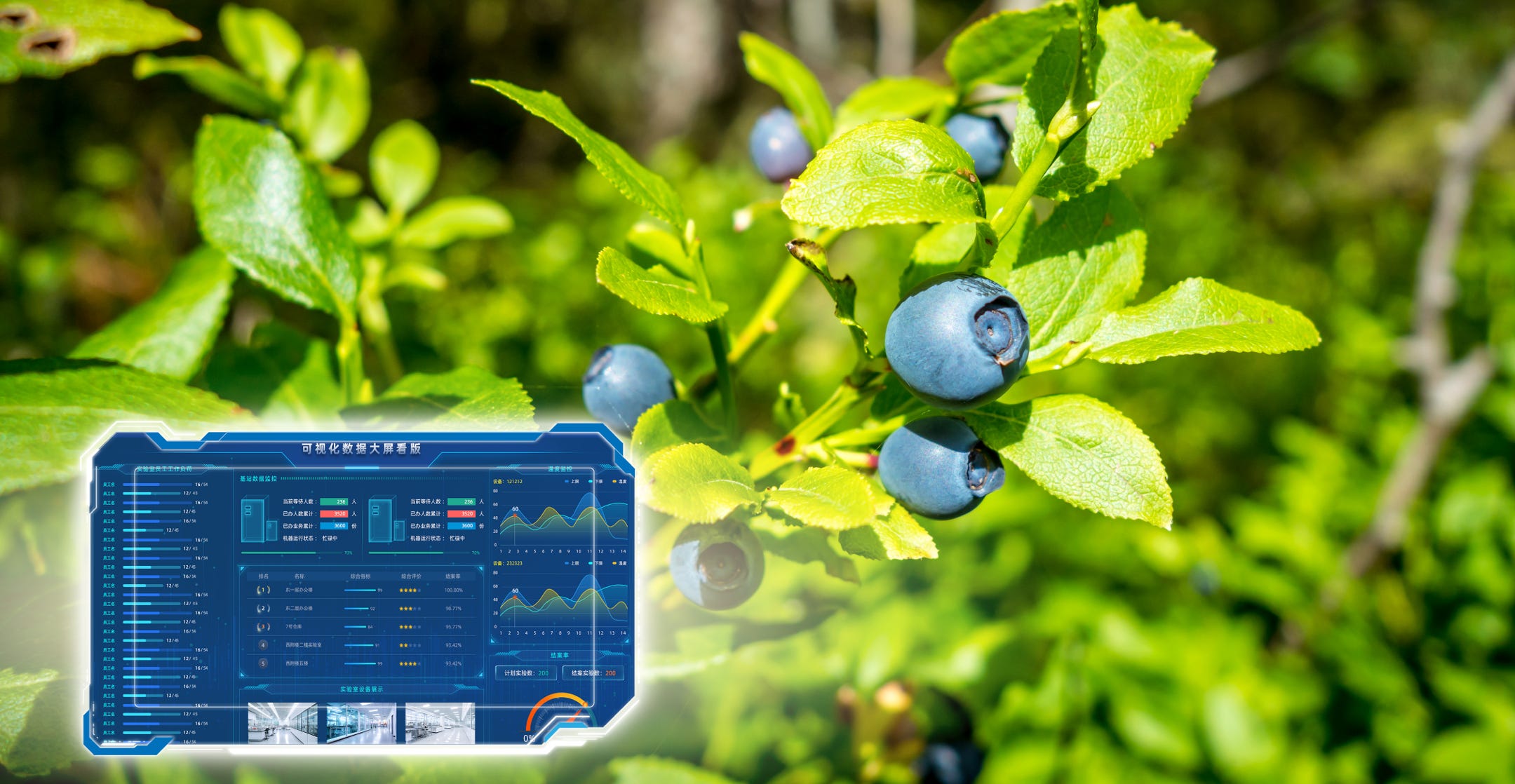
Then came an AI-powered precision agriculture system developed by Maimai Technology, a Chinese agtech startup. With the system in place, blueberry yields jumped 30 percent. Sugar content improved. Color quality reached premium standards. The transformation was quantifiable, dramatic, and begged a question: what technology makes this possible?
The Building Blocks
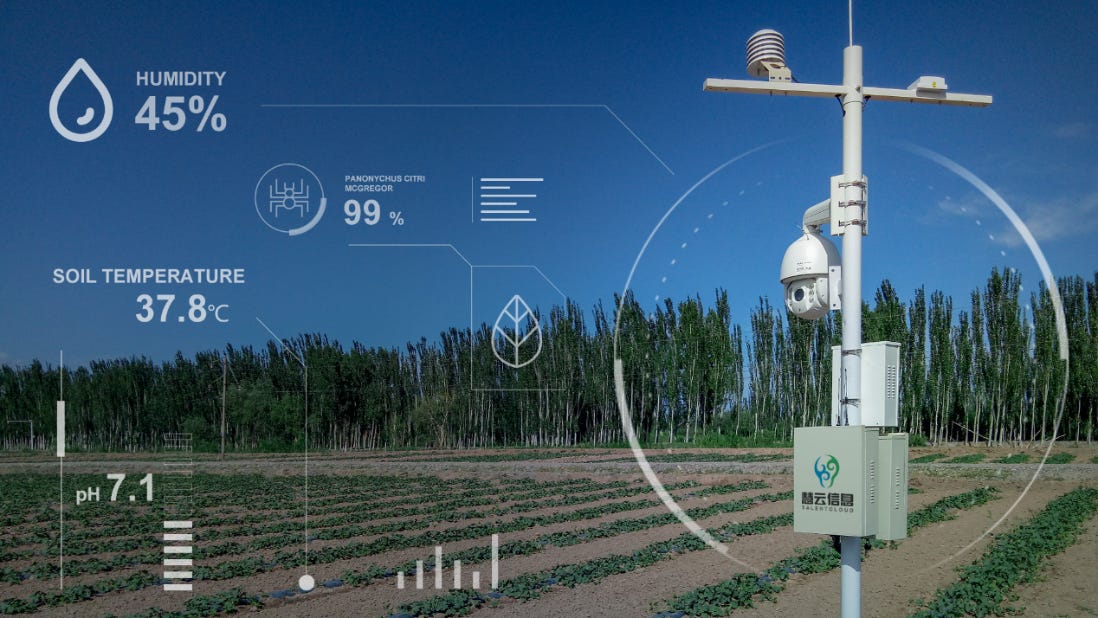
The answer begins underground, with arrays of soil moisture sensors inserted like acupuncture needles into the earth. These sensors—alongside temperature probes, electrical conductivity (EC) meters measuring nutrient levels, pH sensors, and light intensity monitors—form a network that samples conditions every 15 minutes. The technology itself is hardly new; these sensors have been commercially available for over two decades, with individual units costing anywhere from tens to hundreds of yuan. What’s changed is how they’re deployed and connected.
The intelligence lies in what happens with this data stream. When heavy rains saturate the soil, the system automatically suspends irrigation. During drought periods, it flags stress indicators before visible wilting occurs. A sensor network covering a typical greenhouse might cost a few thousand yuan to install—roughly equivalent to two or three consultations with an agricultural technician, but providing continuous, real-time monitoring instead of periodic expert visits.
Above the soil runs a different kind of infrastructure: polyethylene drip irrigation pipes threading between plant rows, studded with precision emitters. At intervals along these lines sit electromagnetic valves controlled by automated systems. When soil moisture drops below optimal levels—levels determined not by human intuition but by real-time sensor data—the valves open. Water mixed with precise nutrient ratios flows to individual plants. This intelligent drip irrigation technology builds on China’s water-fertilizer integration policies that began rolling out in 2016. The impact shows in the data: in Anhui Province’s rice fields, nitrogen fertilizer use dropped 32.5 percent, pesticide applications fell 38 percent, while yields increased 10 to 15 percent. For systems like those deployed by Zoomlion Smart Agriculture, equipment averages just 17.5 yuan per mu (about 667 square meters) annually.
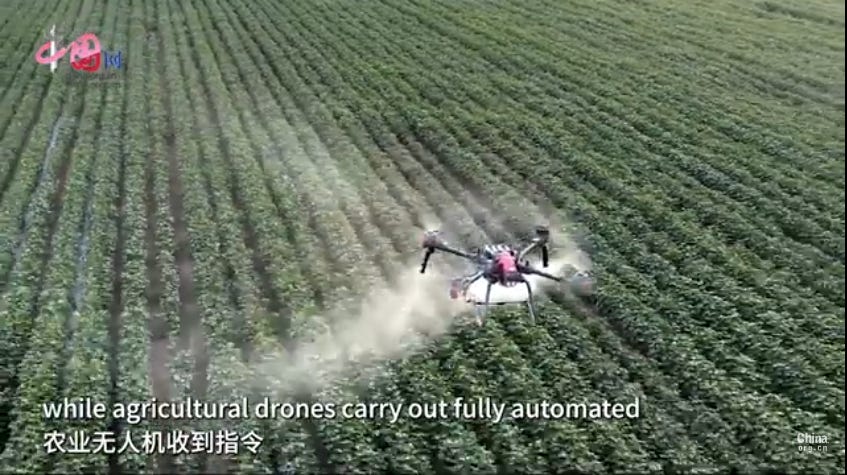
Overhead, agricultural drones equipped with multispectral cameras make regular flights, their sensors capturing wavelengths of light invisible to human eyes. These images reveal what a farmer walking the fields cannot see: subtle variations in plant vigor, the earliest signs of disease stress, areas where nutrient deficiency is beginning. Healthy crops reflect infrared light differently than stressed ones; nitrogen-deficient plants show distinct color signatures in specific spectral bands. AI algorithms process these multispectral datasets, translating color variations into actionable intelligence—marking precisely where pesticides should be applied, or which sections need additional fertilizer, eliminating the wasteful blanket treatments of traditional farming.
All this data—from soil, from sky, from weather forecasts—flows into crop growth models using what developers call a “data and knowledge dual-driven” architecture. The system integrates sensor readings with meteorological predictions and agricultural knowledge graphs compiled from expert experience. The contrast with traditional farming is stark. Previously, a farmer facing a decision would rely on memory, consult thick technical manuals (if they had access), or wait days for a county agricultural extension officer to visit. Now, the output arrives on smartphones as specific, daily instructions: “Today: water 800 milliliters per plant, apply 5 grams nitrogen fertilizer per plant.” No interpretation needed. No expertise required beyond the ability to follow directions. The knowledge barrier has simply dissolved.
The System Integration
These components can only work with the right infrastructure. In Guizhou Province, one of China’s most mountainous and traditionally isolated regions, 5G networks now reach 99 percent of natural villages. This coverage required an investment of 21.1 billion yuan and the deployment of 150,300 base stations—a massive undertaking in terrain where traditional telecommunications infrastructure struggled. The technology enables real-time data transmission with latency dropping from 4G’s 50 milliseconds to just 1 millisecond—fast enough for sensors in remote fields to communicate instantaneously with cloud-based AI systems. Perhaps more remarkably, 96.4 percent of this infrastructure operates on a co-construction, resource-sharing model that dramatically reduces deployment costs.
The full power of these individual technologies emerges through what Chinese agricultural planners call the “five-in-one” integrated system: sky (satellite remote sensing), air (drones), ground (sensors), people (traditional farming knowledge), and machinery (automated equipment). Each component alone offers incremental improvement. Combined, they create something transformative.
In Xinjiang’s cotton fields, XAG Technology’s implementation of this integrated approach enables just two people to manage 3,000 mu—about 500 acres. One person monitors system dashboards, tracking sensor alerts and adjusting parameters. The other conducts physical inspections of equipment and handles exceptions the automated system flags. Previously, this same acreage required a rotating crew of over twenty farmhands during peak seasons. Yields more than doubled from 254 kilograms per mu in 2021 to 529 kilograms in 2024—a 108 percent increase. Water consumption dropped 47.3 percent. Chemical fertilizer use fell 18.2 percent. Pesticide applications decreased 33.2 percent. The insight isn’t about breakthrough innovation in any single technology. It’s about systematic integration of mature, available components working in concert.
This integration didn’t happen by accident. It emerged from continuous policy support spanning 2016 to 2028—a twelve-year arc beginning with water-fertilizer integration initiatives and culminating in comprehensive smart agriculture action plans. The Ministry of Agriculture and Rural Affairs doesn’t just publish policies; it designates successful implementations like the Xinjiang cotton fields and Zoomlion’s Anhui rice platforms as official demonstration cases, creating pathways for knowledge transfer and replication across China’s vast agricultural landscape.
The Knowledge Revolution
All these components and systems serve a single goal: democratizing knowledge. The Shennong agricultural large language model, developed by China Agricultural University, represents perhaps the most direct expression of this ambition. The system has processed 20,000 agricultural books, transforming them into a knowledge graph containing over 10 million entries. It can identify more than 300 pest and disease species. It enables agricultural students to simulate eight years of crop breeding in three seconds.
The interface is remarkably simple. A farmer photographs a diseased leaf and uploads it with a question: “What’s wrong with my tomatoes?” Within seconds, Shennong identifies the pathogen—perhaps a specific fungal infection—and provides treatment protocols tailored to the growth stage and local conditions. Within an hour of its public release, Shennong recorded 100,000 page views and attracted 30,000 registered users.

The transformation is conceptual as much as technological. For millennia, agricultural expertise resided in texts so numerous they could “fill ox carts and crowd library shelves”—the Chinese idiom hàn niú chōng dòng (汗牛充栋) capturing both the vastness and the inaccessibility of this knowledge. Acquiring this expertise meant years of formal agricultural education or decades of trial-and-error experience. Now, that same knowledge responds to voice queries in seconds, explains through images, and adapts to local conditions through multimodal interaction.
Commercial implementations complement this public knowledge base with specialized vertical models. Some companies have developed over 1,000 crop-specific models, each combining plant physiological principles with machine learning tailored to particular species and growing environments. The approach has attracted significant commercial interest, with Maimai Technology raising the largest agricultural technology Pre-A round in China at 100 million yuan. The investment signals market confidence in knowledge democratization as a viable commercial proposition.
From Ox Carts to Apps
Back in Mengzi, that blueberry farmer no longer needs to consult the ox-cart-loads of agricultural manuals. His smartphone app is the expert, ready with answers to “how much water today?” whenever he asks. What AI has accomplished in Chinese agriculture extends beyond increasing yields or reducing costs. It has transformed knowledge itself from a scarce resource hoarded in universities and research institutes into a public good accessible to anyone with a mobile phone. The technical details of sensors and algorithms matter less than this fundamental shift: from knowledge as monopoly to knowledge as democracy.