Beyond the Robot
China's Layered Answer to the 4-2-1 Care Crisis

When Xpeng unveiled its latest IRON humanoid robot at the 2025 AI Day in November, social media erupted—not with applause, but with suspicion. The robot’s movements were so fluid, its gestures so natural, that thousands of commenters insisted it had to be a human in a costume. The CEO, He Xiaopeng, had to post close-up videos of the robot’s joints and servos to convince skeptics. With 82 degrees of freedom—22 in each hand alone—and 3,000 TOPS of computing power, IRON had crossed an uncanny threshold. It looked too real.

This moment matters—not because humanoid robots have arrived at scale (they haven’t), but because it signals how urgently China is addressing a demographic crisis. The modern world is built for human bodies: door handles at human height, stairs designed for human stride, beds sized for human rest. If full-spectrum eldercare is the goal, eventually it may require robots that can navigate the same physical world we do. Xpeng’s plan to mass-produce IRON by late 2026 suggests the technology is maturing faster than many expected.
But China’s answer goes far beyond robots. It’s building a complete care technology stack—from invisible sensors monitoring water and electricity usage to public AI kiosks in every neighborhood—integrated into digital city infrastructure. This layered approach offers Global South countries a flexible deployment path: start with low-cost monitoring, scale with economic growth, and build public AI infrastructure before pushing private devices. The question isn’t whether robots will replace human care. It’s how technology can help societies care better, at scale, and with dignity.
A Demographic Pressure Cooker
The numbers tell a story of structural inevitability. China’s post-80s generation—the first cohort raised under the One-Child Policy—now faces the “4-2-1” trap: two only children, married to each other, responsible for four aging parents. By the end of 2024, China had 310 million people aged 60 and above, representing 22 percent of the population. By 2035, that figure will exceed 400 million—more than 30 percent. The old-age dependency ratio has collapsed from 10:1 in 2000 to 5:1 in 2021. Every five working-age adults now support one elderly person.
The caregiver gap is even more stark. China needs 5.5 million professional eldercare workers, but the industry faces a 50 percent annual turnover rate. Only 500,000 certified caregivers serve 45 million disabled or dementia-affected elderly people. The math doesn’t work. Human-powered care, at this scale, is unsustainable. Technology isn’t a luxury—it’s become a necessity.
Like many in the post-80s generation, I’m an only child married to an only child. We’ll soon be caring for four aging parents, with no expectation our own child will do the same for us decades from now. This isn’t just statistics—it’s our lived reality, and it’s driving technological urgency. The Chinese government has responded with policy force: in January 2024, the State Council issued its first-ever document specifically on the “silver economy,” followed by guidance in December 2024 from the Central Committee promoting humanoid robots and brain-computer interfaces for eldercare. The market is expected to grow from 700 billion RMB in 2024 to 3 trillion RMB by 2035—roughly 10 percent of projected GDP. Demographic crisis is being reframed as economic opportunity.
The Five-Layer Care Stack
Faced with this demographic reality, China is building something more systematic than scattered products—a five-layer technology stack designed for scale, affordability, and gradual adoption. Think of it as concentric rings of protection and support, each layer solving a different problem: sensing, wearing, assisting, informing, and integrating. Together, they form a model that doesn’t require every household to buy an expensive humanoid robot upfront.
The first layer—non-intrusive sensing—may be the most innovative. In Xiong’an New Area’s digital twin city, a community office receives a red alert: “Building XX, Unit 301, Ms. Wang, water usage: 0 liters in past 12 hours, suspected anomaly.” A community worker rushes to the apartment and finds Ms. Wang collapsed in her bathroom, unable to reach her phone. She’s okay—because the system noticed something humans couldn’t. By analyzing water, electricity, and gas consumption patterns, AI builds a behavioral baseline for each elderly resident. Sudden deviations trigger warnings. Tianjin’s “1+3+4” platform—one system, three data types (water, power, gas), four smart device categories—covers 26,000 households using this model. Privacy-preserving millimeter-wave radar adds another layer, detecting falls without cameras. It’s monitoring that respects dignity.
Layer two—wearables—brings health data into continuous focus. Smart bracelets and watches track heart rate, blood pressure trends, blood oxygen levels, and sleep quality around the clock. Exoskeleton robots assist with mobility, weighing just 1.8 to 2.4 kilograms but providing 15 newton-meters of support. The price range—2,000 to 17,000 RMB—reflects deliberate affordability tiering. Fall detection, GPS tracking, and one-button emergency calls turn these devices into lifelines, not just fitness gadgets.
Layer three—service and companion robots—combines physical help with emotional presence. Chongqing’s “Peipei” is China’s first eldercare robot powered by an emotional AI model, capable of multimodal emotion recognition. It doesn’t just obey commands; it reads mood and responds with empathy. In Hangzhou’s Xihu District, a robot named “Xiaoxi” delivers medicine, monitors health, and chats with over 200 elderly residents, its large language model enabling natural conversation. In Wuzhen’s smart eldercare center, robots handle meal delivery in community cafeterias. These aren’t merely tools—they’re companions addressing loneliness, the silent epidemic among China’s 118 million empty-nest elderly.
Layer four—knowledge services—makes AI accessible to those who never learned to type. My parents, in their 70s, now ask Doubao for everything: booking doctor appointments, planning trips, answering health questions. They never mastered smartphone keyboards, but voice interaction changed the equation. Doubao and similar AI assistants offer zero-barrier access through speech. Baidu’s Xiaodu supports 15 dialect variants, ensuring even non-Mandarin speakers can interact effortlessly. Voice-first design doesn’t just accommodate aging—it eliminates the digital divide.

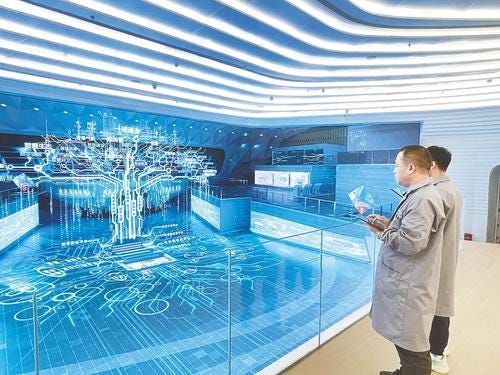
Layer five—system integration—ties everything together through digital twin cities. Xiong’an’s “cloud city” architecture means that community offices receive eldercare alerts alongside traffic data and environmental monitoring. Tencent’s “Silver Guardian” program implements a four-tier response mechanism: when an emergency is detected, the alert cascades from family or caregivers, to community workers, to civil affairs platforms, and finally to 120 emergency medical services, escalating until someone confirms the elderly person is safe. Shanghai’s Hello Elder Friend kiosks use AI to optimize emergency response, analyzing video and voice inputs to prioritize high-risk situations—cutting average response time by 75 percent.
AI as Public Infrastructure
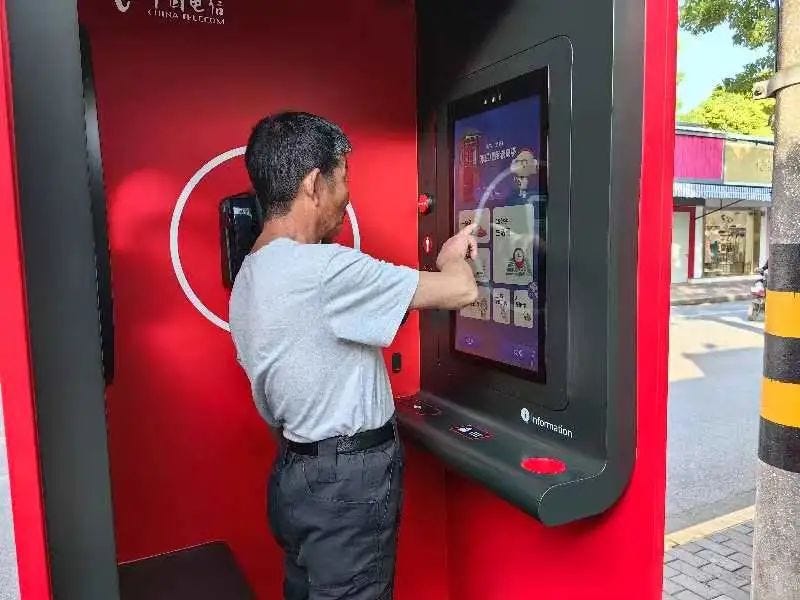
Shanghai offers a different vision: AI as public infrastructure, not private commodity. The city has transformed 3,000 retired public phone booths into “Hello Elder Friend Pavilions”—AI service stations covering 16 districts and 82 subdistricts, reaching 80 percent of residents within a 15-minute walk. Indoor versions have been deployed in community service centers, adding AI social workers and sign language support. It’s a creative repurposing of obsolete infrastructure, turning communication relics into digital service hubs.
The design philosophy is “de-app-ification.” Elderly users don’t need smartphones. They swipe their face or ID card and interact with large touchscreens to book taxis, check pension balances, register for hospital appointments, or pay utility bills. A prominent red emergency button connects directly to community assistance centers and allows unlimited calls to 110, 119, and 120. AI does the heavy lifting: facial recognition simplifies login, natural language processing powers voice-based appointment booking, and multi-language guidance serves diverse populations. It’s technology adapting to people, not the other way around.
This model reveals a values divide. In the United States and much of the West, eldercare technology follows a market-driven path: companies sell devices, elderly individuals or their families buy them, and access depends on purchasing power. China’s model embeds AI services into shared public spaces, ensuring that no one is left behind in the digital transition. The contrast isn’t just technical—it’s political. Under a socialist framework that prioritizes public service, technology deployment looks different. Shanghai’s “thousand screens, thousand faces” customization adjusts kiosk functions to neighborhood demographics and needs, reflecting a commitment to universal access over profit maximization.
This public infrastructure approach is more than convenience—it’s a statement about who technology should serve, and who pays for inclusion. For many Global South countries, where elderly smartphone penetration is low but governments control public spaces, retrofitting community centers and kiosks with AI may be more feasible than distributing devices to every citizen. Public infrastructure scales differently than consumer electronics. It leverages state capacity rather than individual wealth, making it a viable path for nations with resource constraints but functioning public services.
The Question of Care
China’s answer to eldercare isn’t a single humanoid robot—it’s a technology stack ranging from utility sensors to AI assistants, integrated through digital twin city platforms. The Hello Elder Friend Pavilion model demonstrates how public infrastructure can democratize access to intelligent services, prioritizing equity over market demand. China is also shaping global standards: it led the development of IEC 63310, the first international standard for elderly care robots, and has pledged to open-license over 50 patents, lowering barriers for developing countries to enter the field.
Yet technology alone doesn’t solve the fundamental question: what does dignified aging look like? The industry consensus—”assist, not replace”—acknowledges that robots should supplement, not substitute for, human caregivers and family. Machines can lift, monitor, remind, and even comfort, but they remain partners in a triangle of care that includes professionals and loved ones. The question isn’t whether robots can replace human care—it’s whether technology can help us care better, at scale, and with dignity. China’s approach—layered, public-oriented, and pragmatic—suggests one possible answer.