AI Cures a Poor County
Why the Weakest Link Needs Intelligence Most

Tsinghua University’s MedAgent-Zero framework — a simulated hospital where every doctor, nurse, and patient is an AI agent — scores 93.06% on medical licensing exams and achieves a 95.6% correct diagnosis rate. Another system at Shanghai’s Ruijin Hospital analyzes 3,000 pathology slides daily, cutting diagnosis time from 40 minutes to 10. By any measure, China has built world-class medical AI. Yet across the entire country, only 0.7% of hospitals actually use it. Eighty-four percent of those deployments sit inside well-funded urban institutions. The bottleneck is not the algorithm. It is everything else — messy rural clinic data, a vacuum of legal liability when AI makes a mistake, and doctors who understandably refuse to stake a patient’s life on a black box they cannot audit.
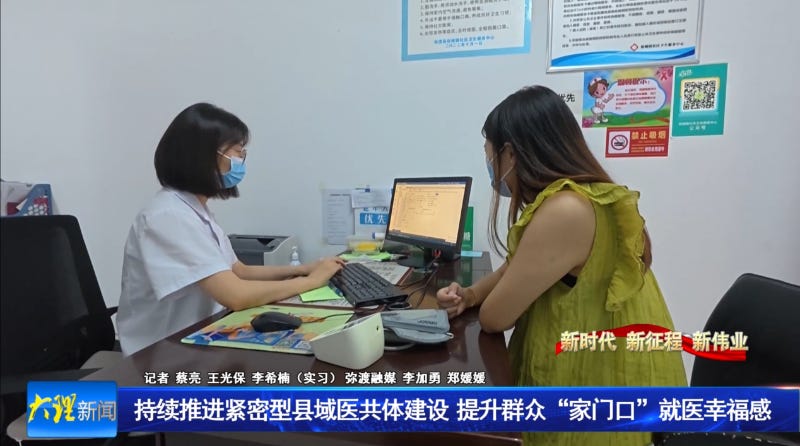
Then there is Midu County. Nestled in the mountains of Yunnan Province’s Dali Bai Autonomous Prefecture, Midu was classified as a national-level poverty county until 2020. Its population of 260,000 is scattered across rugged terrain with a urbanization rate of roughly 40%. What Midu faces is not “how do we make a great hospital greater?” It is a far more basic question: “What do we do when there simply are not enough trained doctors at the grassroots?” The AI system deployed here — covering three county hospitals, eight township health centers, and 89 village clinics — has logged over 900,000 calls as of April 2026. AI’s role is not to outperform specialists. It is to hold the line at the weakest link.
The Floor, Not the Ceiling
The numbers tell a clear story. With AI assistance, grassroots first-visit diagnostic accuracy in Midu climbed above 80%. Misdiagnosis rates fell 20% year on year. Outpatient waiting times dropped from 25 minutes to five, thanks to an AI pre-consultation module that collects symptoms before the patient even sees a doctor. The system functions, in the words of its designers, as a “round-the-clock medical expert permanently stationed at the grassroots” — helping young township doctors correctly identify common conditions and, critically, flag what they should not try to handle alone.
Contrast this with Google DeepMind’s AI co-clinician, tested in collaboration with physicians from Harvard and Stanford. That system is designed for a different world — one of well-resourced hospitals and specialist oversight. In 98 realistic primary care queries, it recorded zero critical errors in 97 cases. Across 140 assessed aspects of consultation skill, it matched or exceeded primary care physicians in 68. The evaluations spanned the United States, India, Australia, Singapore, and the UAE — all environments with functioning digital infrastructure and ample clinical expertise.
Two philosophies, diverging sharply. Google’s AI aims to augment top-tier clinicians — a co-pilot for those who already fly well. Midu’s AI aims to give basic-level practitioners a floor beneath their feet — a safety net for those who might otherwise fall through. One asks, “How can AI match the best?” The other asks, “How can AI help the rest?” The technology providers differ too: a Silicon Valley giant versus the Shanghai Jiao Tong University Chongqing AI Research Institute, a public institution with no commercial product to sell. But this comparison raises a deeper question: why was Midu able to pull this off when 99.3% of Chinese hospitals could not? The answer lies not in technology, but in institutions.
A County Organized First, Then Plugged In
Midu did not drop AI into a vacuum. It spent years building the scaffolding first. In 2022, the county launched what China calls a “compact county medical consortium” — a tightly integrated network that pools personnel, finances, and equipment across all public healthcare facilities. By September 2024, the county government had issued a unified management plan consolidating human resources, budgets, and procurement. Drug purchasing alone, consolidated under a single tender, saved over 9 million yuan. Only in December 2024 did the AI project formally launch — two full years after the institutional groundwork began. Technology came last. Organization came first.
The consortium’s five shared-service centers — medical imaging, laboratory testing, ECG diagnosis, pathology, and sterilization supply — made results mutually recognized across facilities. By the end of 2025, the numbers were striking: 189,234 imaging results shared, 38,135 ECG readings, 11,278 pathology reports, and 322,856 laboratory results. A two-way referral channel connected township and county levels: critical cases moved up, recovering patients moved back down. The infrastructure for data to flow — and for accountability to follow — existed before any algorithm was turned on.
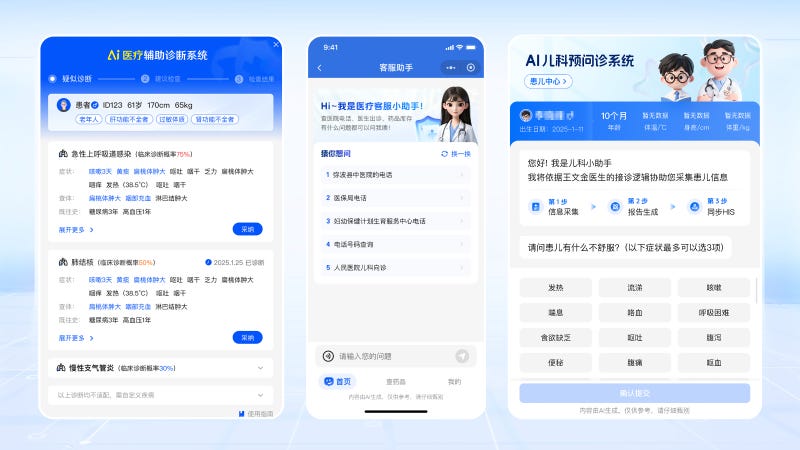
On this institutional base, the “Local Expert Model” took shape. Developed by the Shanghai Jiao Tong team, it fuses a general-purpose large language model with a medical knowledge graph and fine-tuning on more than 70 million local health records. The concept is straightforward: capture the clinical wisdom of Midu’s best county doctors and distill it into a replicable digital asset — not a generic AI that knows everything about academic medicine, but one that knows what actually works in Midu’s disease landscape. The grassroots diagnostic module alone has been called over 300,000 times.
The human layer matters as much as the digital one. Zhao Yanting, a nurse at the Daying Village Clinic in Hongyan Township, makes monthly rounds to check on chronic disease patients. She uploads examination data in real time to the consortium’s big data center, where it feeds directly into each patient’s longitudinal health record. Under the “examine locally, diagnose at county level” model, a township doctor completes an ECG or a chest X-ray; a county specialist reads it and returns a report — sometimes in as little as two minutes. For Pan Wenhong, a resident of Donghe Village in Xinjie Township, this network was literal lifesaving: when a sudden cerebral infarction struck, the consortium’s 24-hour green channel rushed her through to emergency care. If Midu’s story resonates beyond its borders, it is because the challenges it faces — too few doctors, uneven quality, poor connectivity between levels of care — are hardly unique to one Chinese mountain county.
What a Poor County Teaches the Global South
In Africa, there is roughly one doctor for every 3,000 people. The World Health Organization projects a shortfall of 4.3 million physicians by 2035. Globally, just 3% of the healthcare workforce serves 17% of the population. These are not abstract statistics — they describe the daily reality of billions of people whose first point of contact with medicine is an under-trained community health worker, if they reach one at all. Midu’s starting condition was not so different.
Yet most AI healthcare experiments in the Global South remain fragmented. Kenya’s Ilara Health partners with over 3,000 clinics across 46 counties, providing diagnostic devices and software — but without the kind of unified institutional backbone that Midu built. India’s rural tele-radiology initiatives face similar fragmentation. A scoping review of AI healthcare in low- and middle-income countries identifies the recurring obstacles: poor data quality, infrastructure gaps, absent regulatory frameworks, low digital literacy, and dependence on external funding that may vanish when the pilot ends. Only 5.2% of federated learning studies in healthcare have achieved real-world deployment. The technology exists. The institutional architecture to absorb it typically does not.
Midu offers an alternative template — a “government-led, university-powered, hospital-coordinated” triad in which no single actor dominates. The county government set the institutional rules and funded the network. A university research institute provided the technology without a commercial product agenda. The consortium’s hospitals delivered the clinical ground truth. The key insight transferable beyond China is not any specific algorithm but a sequence: organize first, plug in technology second, and position AI to augment — not replace — the human chain of care. Countries with different political systems will adapt this in different ways. The logic of “institutions before algorithms” is universal.
What Midu Proved
The core lesson of Midu is not “AI is powerful.” It is that making AI serve the people who need it most requires more than better algorithms. Midu got the organization right before it got the technology — building a consortium that unified data, personnel, and accountability across three tiers of care, then embedding AI into that readymade structure. It chose to raise the floor rather than chase the ceiling.
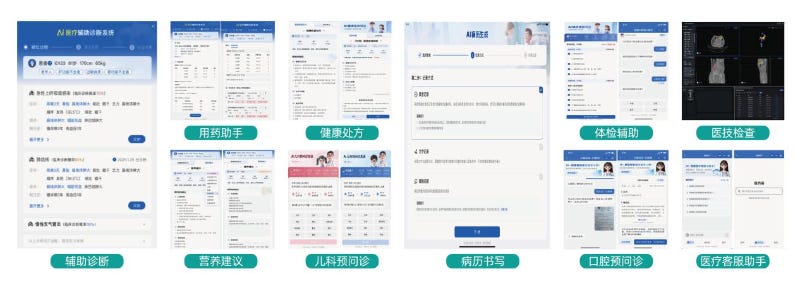
The elements worth studying — the tripartite cooperation model, the compact medical consortium structure, the philosophy of AI as embedder rather than replacer — will need different adaptations in different institutional contexts. No one should copy Midu wholesale. But the sequencing logic transfers: where healthcare is weakest, technology alone will not stick without an institutional substrate to hold it.
In June 2026, China added 12 AI-assisted diagnostic services to the national medical insurance catalog, giving projects like Midu a potential reimbursement pathway. Whether this solves the sustainability question remains to be seen.
What Midu proved, at minimum, is that the bottleneck for AI in healthcare is not in the laboratory.